

Generative AI & LLMs
LLM Development Company vs. Generic AI Vendor: What to Actually Look For
Written by Tehreem FatimaReviewed by Umaid Asim
Published 8 min read

Choosing an LLM development company takes more than checking whether “AI” appears on its service list. The useful distinction is whether the team assigned to your project can show relevant delivery experience, explain how it will test the system, and put data and support responsibilities in writing. A specialist label alone does not establish any of those things.
This piece gives you five questions to ask before you sign anything. It is a practical first-call filter, not a replacement for security review, references or a formal procurement process.
What “LLM development company” actually means
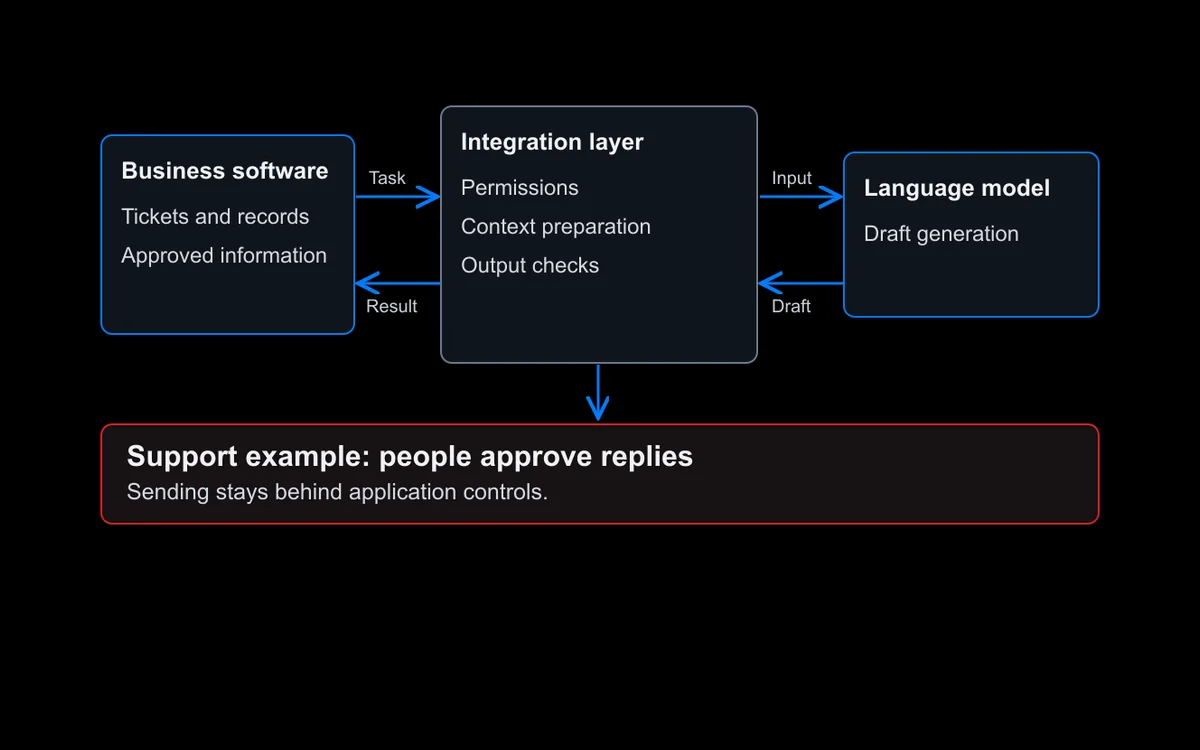
An LLM development company builds systems where a large language model does useful work inside your product. Depending on the problem, that might involve retrieval-augmented generation, fine-tuning, agentic workflows or a simpler model API integration. Not every application needs every technique. The important skill is choosing an approach that fits the task and testing whether it works. Anthropic’s engineering guidance similarly recommends starting with the simplest solution and adding complexity when it demonstrably improves outcomes.Source [3]
A “generic AI vendor” is not a formal technical category. Here, it means a provider offering AI within a broader software portfolio. That alone tells you little about the engineers assigned to your project. A general software firm may have strong LLM expertise, while an AI-focused firm may still lack experience with your data, constraints or operating environment.
Neither label is a guarantee of quality, and the line between them is not always sharp. The point of this piece is to give you specific questions to ask, not a type of company to rule out on sight.
Why the distinction is worth your time
The cost of a weak delivery plan may appear after a convincing demo. A chatbot answering a few prepared questions does not show how it handles missing evidence, restricted documents or changing inputs. For example, adding outdated files to a knowledge base could introduce conflicting answers unless the system handles document versions and retrieval quality. This is an illustrative failure scenario, not a claim about any particular vendor.
None of this means you always need a specialist. A narrow, low-stakes use case may be well served by a general vendor. But “internal” does not automatically mean low-risk: an employee FAQ assistant could still expose confidential information. Match the evaluation effort to the sensitivity of the data, the actions the system can take and the consequences of a wrong answer.
Five questions that actually separate the two
Use these questions to compare the evidence behind each proposal. A first call should establish what the team can demonstrate and what still needs investigation, rather than settle every architecture or compliance decision.

1. Is LLM work their specialty, or a service they added?
Ask directly how much of their current work involves LLMs, then ask who will actually build your system. Their relevant experience matters more than how long the company has used an AI label. A recent change in positioning is a reason to inspect the evidence, not an automatic red flag. Ask the proposed technical lead to explain a past architecture decision and the trade-off behind it.
2. Can they show a real production system, not a demo?
A polished demo proves a team can build a demo. Ask for a system used in production and what the team learned after launch. Look for specifics about testing, operating constraints and improvements, rather than only a successful launch story. If confidentiality prevents disclosure, ask for an anonymised walkthrough or a reference the client has authorised. Missing public case studies alone do not prove a lack of experience.
If you plan to hire large language model developers directly instead, ask candidates the same thing: what did they personally build, and what happened when real users used it?
3. How do they handle your data?
This is really several questions: where data is processed and stored, how long it is retained, whether providers can use it for training, and who can access it. Include prompts, retrieved documents, logs and backups, not just the original database. Ask which model hosts and other subprocessors receive the data, and how deletion and access controls work.
Get the relevant commitments in writing. Where UK GDPR applies and a supplier processes personal data on your behalf, controller and processor roles and contractual requirements need specific attention. An NDA covers confidentiality; it is not a substitute for applicable data-processing terms. The ICO explains these responsibilities in its controller and processor guidance.Source [1]
4. What does their testing and evaluation process look like?
Ask what they check before a system goes live, not just whether it “seems to work” in a few manual tries. A useful answer describes representative test cases, expected outcomes and how failures are reviewed. GitHub’s evaluation guidance explains why application-relevant evaluation matters before production.Source [2]
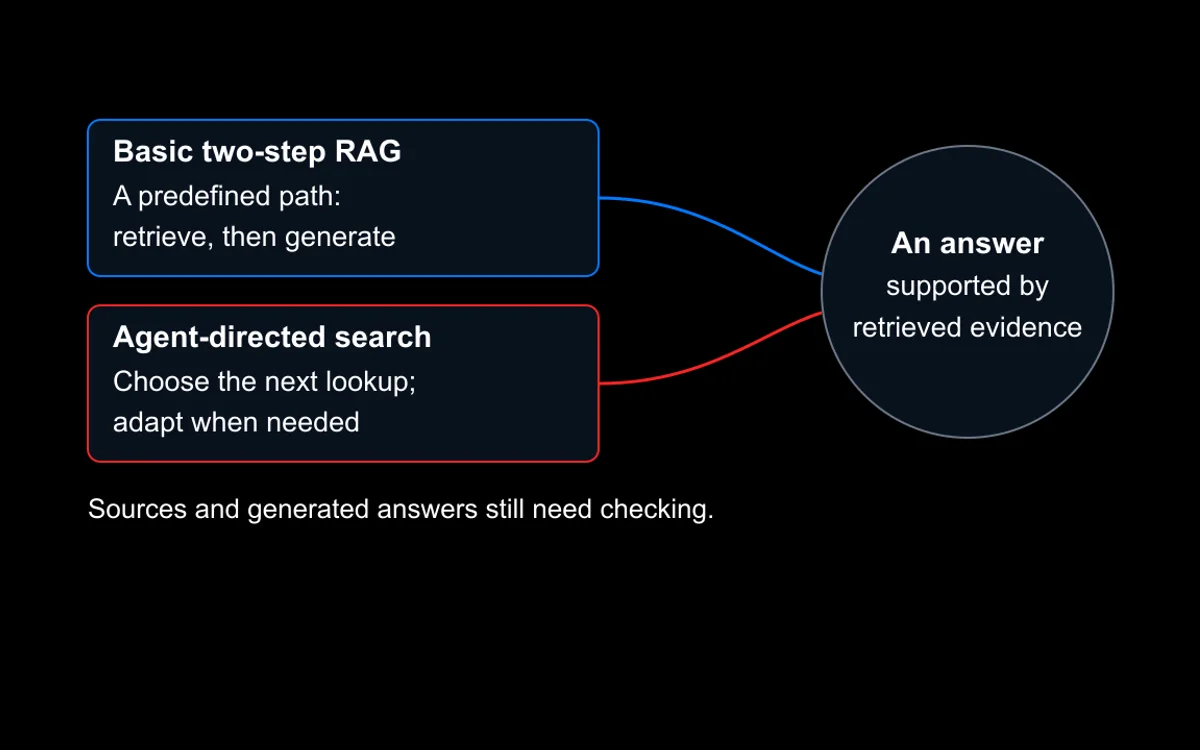
For a RAG system, ask about retrieval quality and whether answers are supported by the retrieved evidence. For an agent that can change records, ask about permissions, tool actions and approval steps. No test set guarantees that hallucinations or unsafe behaviour cannot occur. Agree which failures block release and how changes will be retested. Our overview of AI evaluation tools explains the role of different testing approaches.
5. What is the engagement model, and what happens after launch?
Find out whether you are buying a fixed-scope build, an ongoing managed service or something in between, and what support looks like once the system is live. Application quality can change when documents, prompts, models or user behaviour change, even if the original model stays the same. Ask who monitors failures, who fixes them and what that support costs.
Also agree on access to source code, evaluation data, deployment accounts and documentation. Ask what you can export or move at the end of the engagement. Changing a model or database may require integration work and fresh testing; an interchangeable interface is not a promise of a cost-free migration.
Red flags worth taking seriously
A few patterns deserve a follow-up before you commit. Judge the quality of the answer and the supporting evidence, rather than expecting every provider to arrive with the same technology choices.

Be cautious when a team cannot offer any credible delivery evidence, even through confidential alternatives. Likewise, answers built entirely from marketing language need a second, more pointed conversation about your actual problem.
Not naming a final model before discovery is not itself a red flag. Responsible selection may require testing candidate models against your tasks, quality requirements, latency and budget. The concern is having no clear selection criteria, evaluation plan or explanation of the proposed approach. Starting with a simpler design can be the right decision.Source [3]
A proposal with no evaluation plan or no owner for post-launch failures is also incomplete. Ask for these responsibilities to be added before comparing it with a proposal that already includes them.
Build, buy, or hire a specialist
This decision sits next to a related one: whether to build in-house, buy an existing product or hire a development partner. For applications that retrieve answers from your documents, a managed RAG provider is another option. Our guide on RAG as a service explores that narrower decision; RAG is not required for every LLM application.
The questions in this piece apply to both a custom build and a managed service, but the evidence will differ. A development partner should clarify handover and ownership. A managed provider should explain service boundaries, ongoing support and what happens when you leave.
Where this fits at SensViz
SensViz works on generative AI and LLM systems, including application integration, retrieval and evaluation. If you are weighing a custom implementation, bring a defined use case, a description of your data and the constraints the system must meet. That gives the conversation a more useful starting point than choosing a model first.
To discuss what your business needs and what a suitable engagement could include, contact SensViz. Scope, data handling, handover and ongoing support should be agreed for the specific project.
FAQ
These are common decision points to clarify when comparing LLM development services and proposals.
Is a specialist LLM development company always more expensive than a generalist vendor?
Not necessarily, but neither label establishes the total cost or delivery speed. Compare proposals covering the same scope: discovery, integration, evaluation, hosting, model usage and support. A lower hourly rate is not enough to establish a cheaper project, and a specialist rate does not prove less rework.
Can a generic AI vendor still be a good fit for a simple project?
Yes, if the assigned team can demonstrate the skills the project requires. Keep evaluation proportionate to risk, but do not skip basic testing, data controls or ownership of failures simply because the tool is internal or the dataset is small.
What is the difference between an LLM development company and a large consultancy?
A provider’s size and positioning do not reliably describe the team you will work with. Compare the named engineers, access to technical decision-makers, relevant delivery evidence and contractual responsibilities. Ask about subcontractors and staff changes as well as the company’s overall portfolio.
What is a reasonable way to test a vendor’s claims before committing?
Consider a small, paid pilot on a limited version of your use case, with agreed test cases and acceptance criteria. Use data you are authorised to share and suitable privacy controls. Include difficult cases, not just a demonstration of the happy path. A successful pilot provides evidence, but does not replace production security, scale and operational checks.
Does a bigger company automatically mean lower risk?
No. Size alone proves neither financial stability nor relevant engineering capability. Check the actual delivery team, continuity arrangements and references, alongside the same data, evaluation and support questions you would ask a smaller provider.
Sources
- [1] A guide to controllers and processors, Information Commissioner’s Office (opens in a new tab) Accessed 16 September 2026.
- [2] How to evaluate LLMs before production, GitHub Blog (opens in a new tab) Accessed 16 September 2026.
- [3] Building effective agents, Anthropic (opens in a new tab) Accessed 16 September 2026.