

Custom AI development services
Custom AI Development
Built for Real-World Use
SensViz designs and engineers custom AI systems around your business requirements, available data, users, and existing software. From feasibility to deployment, every part of the system is shaped by how and where it will be used.
AI products designed and built by SensViz










When off-the-shelf AI is not enough
Where generic AI stops, custom development starts
Custom AI development means designing an AI system around a specific business problem, dataset, product, or operational requirement. It becomes useful when the result depends on proprietary knowledge, unusual data, strict accuracy or privacy needs, or an experience a general-purpose tool cannot provide. SensViz defines the decision, prediction, interaction, or insight first. We then assess the available data and constraints before selecting a model, retrieval method, application flow, and integration approach. The result may be a recommendation engine, forecasting model, private knowledge system, computer vision application, or focused AI feature inside existing software. We do not recommend custom AI when a standard product, analytics workflow, rule, or conventional software feature will solve the problem more simply.
Built on your data
Your own data and business rules shape the solution, not a generic template.
Requirements first
Scope, constraints, and success measures are agreed before any model or vendor is chosen.
Designed for production
Quality, privacy, latency, cost, and human oversight are designed together.
Delivered as a product
The AI ships as a usable product feature or operational tool, not a demo.
What we build
Custom AI development services built for clear business outcomes
Each engagement starts with the task the system must improve. SensViz then selects the smallest dependable technical approach that can deliver the required result.
Recommendation and personalization systems
Rank products, content, funding, services, or next steps using the behavioral signals, business rules, similarity, and feedback that matter in your context. The system can combine learned patterns with clear editorial or eligibility controls.
Predictive models and decision support
Use historical and current data to forecast demand, risk, quality, usage, or operational conditions. Outputs can support dashboards, alerts, planning, and human review rather than making unchecked decisions.
Generative AI, LLM, and RAG applications
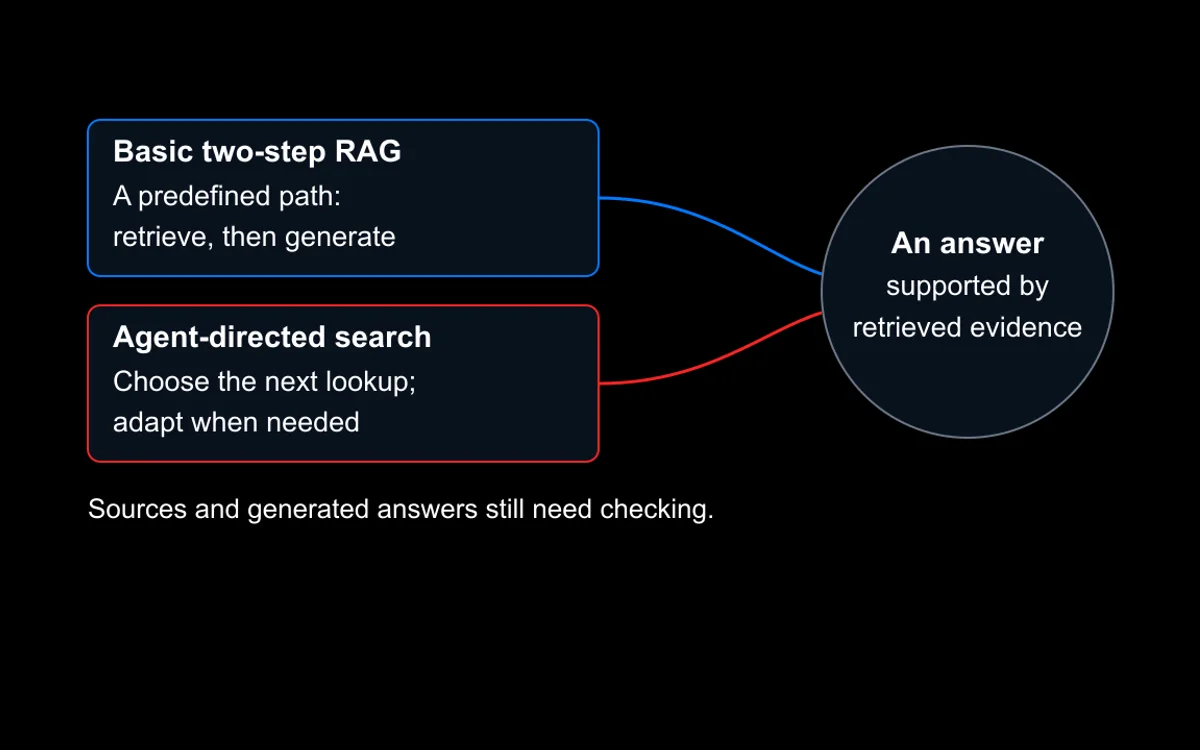
Retrieval-augmented generation over approved sources, assistants and copilots, structured generation, and multimodal features. These are built as a dedicated Generative AI and LLM engagement.
Computer vision solutions
Interpret images or video for recognition, classification, tracking, inspection, measurement, visualization, or guided experiences. The model and application are designed together so the output is useful in context.
AI integration and model adaptation
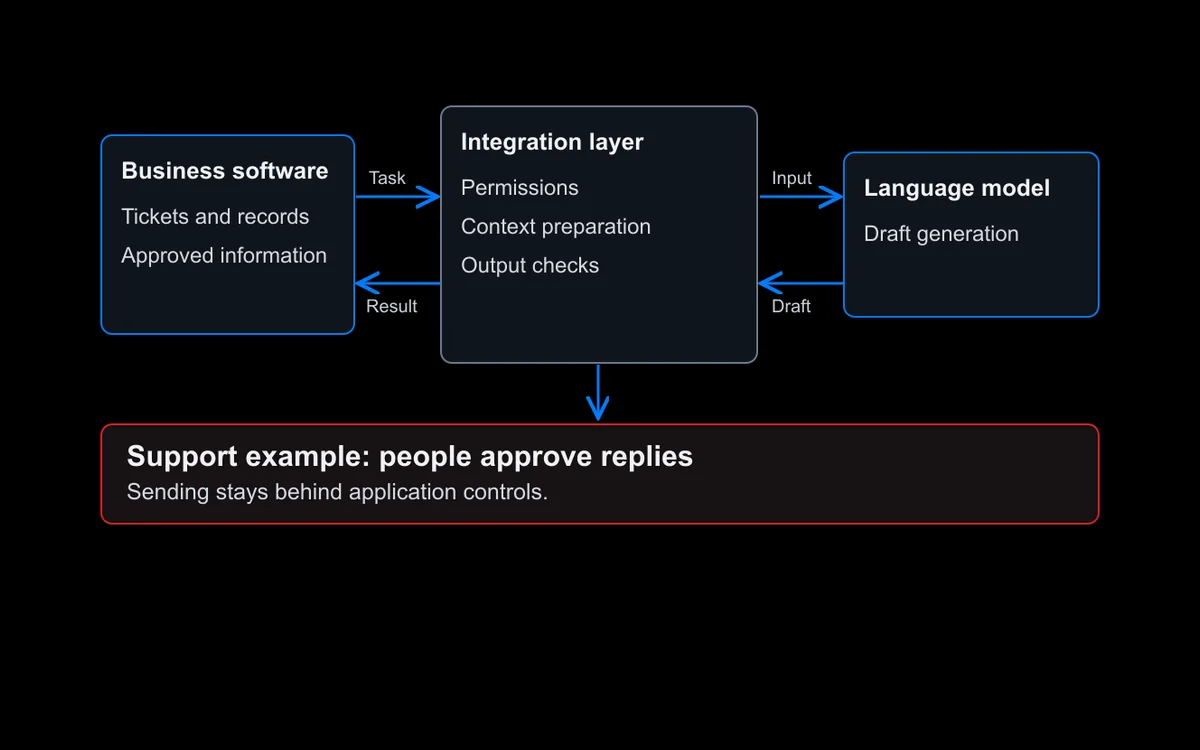
Add a focused AI capability to existing software or adapt a suitable model through prompting, retrieval, fine-tuning, routing, or domain-specific evaluation. We use the least complex approach that meets the requirement.
Technology approach
A modern AI stack chosen for the job
We work across commercial and open-weight models, retrieval systems, machine learning frameworks, and managed cloud platforms. The stack is selected against the real task, data, environment, quality threshold, privacy needs, latency, operating cost, and ownership model. No project needs every tool listed below.
Foundation and multimodal models
OpenAI, Anthropic Claude, Google Gemini, and suitable open-weight models available through Hugging Face. Candidates are tested against representative work rather than chosen by reputation alone.
Retrieval and data systems
Focused retrieval pipelines using PostgreSQL and pgvector, Pinecone, Weaviate, approved document storage, and fit-for-purpose data services. The design depends on permissions, scale, freshness, retrieval quality, and cost.
Machine learning and computer vision
PyTorch, scikit-learn, XGBoost, OpenCV, and task-specific models when they fit the data and requirement better than a general foundation model.
Deployment, evaluation, and observability
AWS Bedrock, Google Vertex AI, Microsoft Foundry, containers, and standard cloud infrastructure, supported by representative evaluation sets, human review, tracing, and quality, latency, and cost monitoring.
Where custom AI creates value
Use AI where better judgment, prediction, or interpretation matters
The strongest custom AI use cases have a defined user, a repeatable task or decision, relevant data, and a measurable standard for useful behavior.
A good first use case usually has
- A costly or slow decision, interpretation, matching, or review task
- Relevant data, or a realistic way to collect and govern it
- A user who can act on, approve, or correct the output
- A measurable definition of useful, accurate, and acceptable behavior
- A clear path into an existing product or operational process
Personalized discovery
Recommend and rank relevant products, services, content, opportunities, or next steps for each user.Forecasting and early warning
Predict changes in demand, quality, usage, risk, or performance so teams can respond sooner.Visual recognition and guidance
Interpret images or video to identify objects, inspect conditions, track movement, or support interactive guidance.Private knowledge and document intelligence
Extract information, retrieve approved context with citations, compare records, or help users work through complex documents.Multimodal product experiences
Combine text, images, audio, and structured data when the user task cannot be solved through one input type.Customer and employee decision support
Surface relevant evidence, patterns, and suggested next steps while leaving consequential decisions with people.AI features inside existing products
Add search, recommendations, language understanding, prediction, or visual intelligence to a live application.Reliable by design
A useful model needs a dependable system around it
Production AI depends on more than a promising model response. Data quality, evaluation, permissions, latency, cost, fallback behavior, monitoring, and product experience all affect whether people can use the system with confidence after launch.
Data readiness
Assess quality, coverage, access, labeling, privacy, and known limitations before committing to an approach.
Measurable evaluation
Test representative cases against business-defined acceptance criteria, not only a polished demonstration.
Human oversight
Allow higher-impact outputs to be reviewed, approved, corrected, or rejected before a consequential action.
Security and privacy
Design access, storage, model providers, logging, and data flows around the sensitivity of the use case.
Fallback behavior
Handle low-confidence, missing-data, and exception cases explicitly instead of hiding them behind a confident response.
Monitoring and improvement
Track quality, errors, drift, latency, usage, and cost so the system can be maintained and improved.
How we deliver
From a defined problem to monitored AI software
Every engagement moves through a decision-led process. This keeps the technical work tied to a practical outcome and gives stakeholders clear review points before the scope expands.

Business and use-case discovery
Define the user, current process, business constraint, desired outcome, available data, and the task or decision the AI must improve.
Feasibility and data assessment
Review data access and quality, technical constraints, integrations, risk, privacy, and whether custom AI is the right approach.
Solution design and success criteria
Design the model or retrieval approach, application flow, APIs, interfaces, oversight, and measurable acceptance criteria.
Prototype and evaluation
Test the highest-risk assumptions with representative data and realistic cases before committing to a larger production build.
Product integration and deployment
Build the supporting software, connect approved systems, deploy the AI capability, document it, and prepare users for launch.
Monitoring, support, and improvement
Track real-world behavior, address failure cases, refine quality and cost, and expand the system when the evidence supports it.
Commercial principle: Discovery should produce a clear recommendation, not a commitment to use AI. If a standard product, automation, analytics workflow, or conventional feature is the better answer, SensViz should say so.
Selected work
Selected custom AI work
SensViz has applied recommendation systems, language models, computer vision, and forecasting inside customer-facing products. These examples show the work without adding performance claims that have not been documented.
GrantMatch: AI grant recommendations
GrantMatch combines language models, recommendation logic, and vector search to surface grant opportunities relevant to each user's profile and needs.
Relevant capability: recommendation systems, retrieval, language AI, contextual matching
CV Jury: AI-assisted cover letters
CV Jury uses language models and natural language processing to help users create cover letters based on their background and target role.
Relevant capability: language intelligence, structured generation, user context
Playano: computer vision learning
Playano uses computer vision to interpret hand movement and provide visual guidance during piano practice.
Relevant capability: computer vision, real-time interaction, education technology
SIPP: water-quality forecasting
SIPP uses time-series forecasting to interpret water-quality data and support monitoring of changes over time.
Relevant capability: forecasting, sensor data, decision support
Why SensViz
AI engineering grounded in product and business reality
Problem-first scoping
Define the business requirement and success criteria before choosing a model, framework, or vendor.
AI and software in one team
Design models, data, APIs, interfaces, integrations, deployment, and product experience as one system.
Human-centered decisions
Give users clear controls, understandable outputs, and appropriate oversight around the work the AI supports.
Production-minded delivery
Include evaluation, fallback behavior, monitoring, documentation, and maintainability in the engineering approach.
Technology without unnecessary lock-in
Select tools around quality, privacy, cost, portability, and maintenance rather than forcing one vendor onto every project.
Clear ownership and support
Define code, infrastructure, data responsibilities, model access, third-party licensing, documentation, and post-launch support in the agreement.
Related AI and software services
Choose the service that matches the work
Custom AI is the right starting point when the capability must be designed around your data, product, or decision. Use the related services below when the main job is narrower.
Frequently asked questions
Custom AI development is the design and engineering of an AI system around a specific business problem, dataset, product, or operational requirement. It can include models, retrieval, data pipelines, APIs, interfaces, integrations, deployment, evaluation, and ongoing monitoring.
Custom development is worth considering when the result depends on proprietary data, unique rules, strict quality or privacy needs, deep integration, or an experience standard tools cannot provide. If an existing product can solve the problem reliably, buying or integrating it is usually the simpler option.
SensViz works on recommendation and personalization systems, predictive models, computer vision applications, and focused AI capabilities inside existing software. Generative AI, LLM, and RAG applications are delivered as a dedicated generative AI and LLM development engagement.
Not always. The requirement depends on the task and technical approach. During discovery, SensViz assesses available data, quality, access, gaps, privacy, and whether retrieval, commercial models, rules, fine-tuning, synthetic data, or additional collection can support a useful first version.
Yes. SensViz can assess the current architecture and add a focused AI capability through APIs, retrieval, model services, custom components, or supporting interfaces. Integration is planned in stages to reduce disruption to the live product.
SensViz defines representative test cases and acceptance criteria around the real task. Depending on the system, evaluation may cover accuracy, relevance, false positives, consistency, safety, latency, cost, and how low-confidence or exception cases are handled.
Cost depends on the use case, data readiness, integrations, model requirements, user experience, deployment environment, and support scope. SensViz provides a project estimate after discovery and feasibility review.
Ownership of custom code, project assets, model access, infrastructure, and third-party licenses is defined before development begins. The agreement should state what your team owns, what remains third-party, and what post-launch support is included.
The timeline depends on data readiness, technical risk, integrations, model requirements, user experience, and deployment scope. After discovery, SensViz provides a phased plan that tests the highest-risk assumptions before expanding into a production build.
Working out budget? See the pricing factors behind a custom AI project.
Start with the problem
Build the AI capability your business can actually use
Tell us what your team needs to predict, understand, recommend, or improve. We will help you determine whether custom AI is the right approach and outline a practical first step.
If a standard product or simpler software solution fits better, we will say so.