
Generative AI & LLMs
RAG as a Service: What It Means and How to Decide If You Need It
Written by Tehreem FatimaReviewed by Umaid Asim
Published 15 min read

RAG as a service is an umbrella term for paying an outside team to help connect a large language model to your own documents and data, so it can answer questions using your actual information instead of general knowledge alone. The scope varies by provider, so ask what is included before comparing offers.
Custom RAG development is usually a project: a provider builds a retrieval-augmented system scoped to your use case and hands it over, with your team taking on hosting and operation afterward. A managed RAG service typically goes further, with the provider continuing to operate specified parts of the system after launch. Some providers instead offer a hosted platform with managed retrieval built in, without a fully custom implementation. These approaches can overlap: an external development team may build on a hosted platform and hand the application over to you.
Many teams reach for this option after trying a general-purpose AI assistant and finding it does not know their internal processes, product catalog, past support tickets, or policy documents. Depending on the scope you agree, RAG as a service can reduce the need to build an in-house machine learning team, evaluate vector database options in depth, or work out chunking and retrieval tuning from scratch.
This guide covers what the term actually means, how it compares to building in-house or using a pre-built tool, a self-assessment to help you decide, and the questions worth asking any provider you evaluate, SensViz included.
RAG as a Service vs. RAG Development Services
The two terms get used almost interchangeably, but they point at slightly different things. RAG development services usually refer to the build itself: scoping the use case, connecting your data sources, setting up retrieval, and shipping a working system. A managed RAG service adds ongoing operation, monitoring and maintenance; a build-only engagement does not. Providers use these labels differently, so confirm the scope.
Providers differ in how they scope this. Some default to a build-only engagement, some to an ongoing managed arrangement, and some offer either depending on what you ask for; do not assume any specific provider offers both without confirming it. A team with its own engineering capacity might want a build focused on getting the initial system right, then take over monitoring themselves. A team without that capacity is more likely to want a fuller, ongoing arrangement.
What Retrieval-Augmented Generation Actually Does
If you are new to the term, retrieval-augmented generation, RAG for short, works by searching your approved documents and data for the passages most relevant to a question, then handing those passages to a language model along with the question itself, so the model answers using that retrieved information rather than relying only on what it learned during training.Source [1]
This matters for two reasons. First, it lets the system answer questions about information that did not exist when the underlying model was trained: your latest product specs, this quarter’s policy update, a document uploaded yesterday. Second, done well, it lets the system point back to the source it used, so a reader can verify the answer instead of taking it on faith.
Retrieval can improve grounding, but it does not guarantee a correct answer. Results still depend on source quality, retrieval performance and how the model uses the evidence.
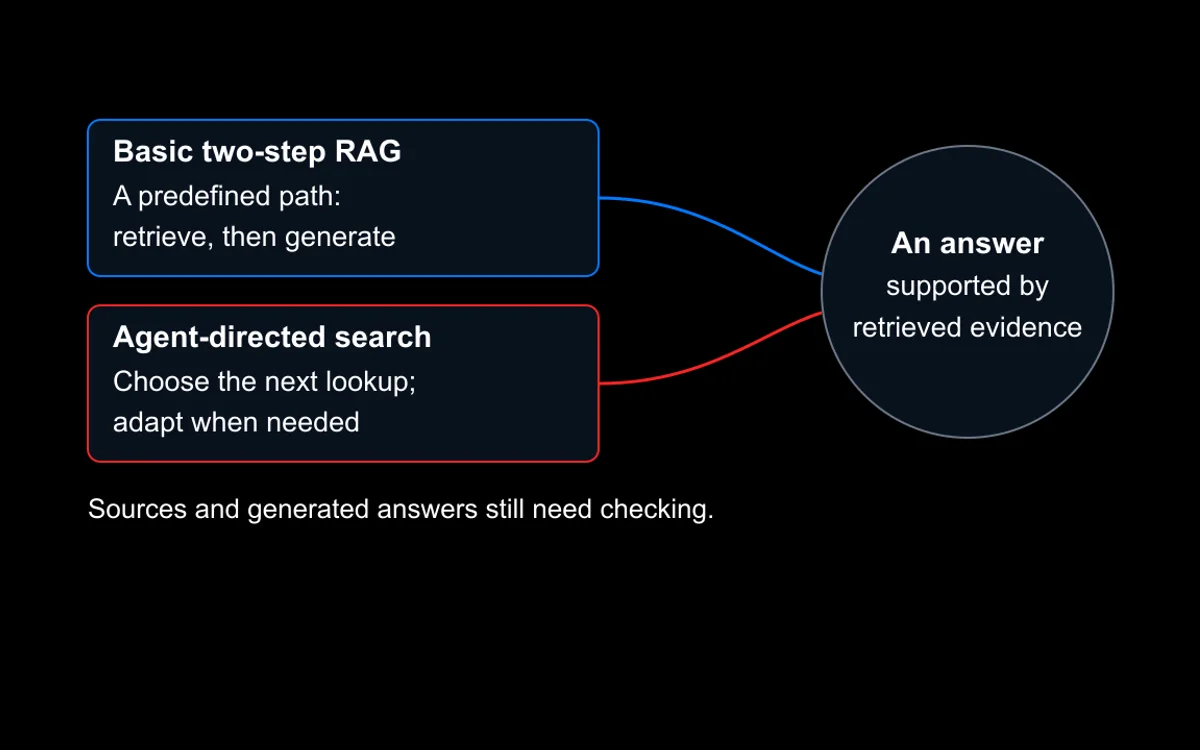
A basic RAG pipeline follows a predefined retrieval step. Some systems instead let the model choose and revise its own searches as it goes. If a task needs follow-up searches rather than one fixed lookup, our comparison of agentic search and RAG explains that architectural choice. For a deeper, more technical look at how the retrieval pipeline itself is built, evaluated, and tuned, see the RAG architecture and retrieval quality guide.
Common Use Cases for RAG as a Service
These are illustrative examples of the kinds of problems teams typically bring to a RAG as a service engagement, not specific delivered projects unless stated otherwise.
A support team buried in repetitive tickets can let agents, or customers directly, search past resolutions and documentation in plain language instead of digging through a wiki. In sales, the same approach can pull up a relevant case study, pricing sheet, or technical answer mid-conversation, sourced from an internal knowledge base rather than recalled from memory. It also shows up in operations, where a policy manual or compliance document that used to mean handing someone a 40-page PDF becomes something they can just ask a question about.
SensViz built and handed over GrantMatch, which combines language models, recommendation logic, and vector search to match users with relevant funding opportunities. It illustrates a custom-build-and-handover approach rather than an ongoing managed RAG service: SensViz built the system, but is not the one operating it day to day.
What You Hand Over vs. What You Keep
A RAG as a service arrangement splits responsibility between you and the provider. What that split looks like varies by provider and by how much of the work you want to keep in-house, and by whether the engagement is build-only or includes ongoing operation.

| Area | Typically handled by the provider | Typically stays with you |
|---|---|---|
| Data sources and knowledge base | Structuring and indexing your content for retrieval | Deciding which documents, systems, and data are approved sources |
| Hosting and security | Infrastructure, access controls, and system design, as scoped in the engagement | Data classification, permissions, and internal approval policy |
| Model selection | Evaluating and configuring the language model and retrieval components | Business requirements the system must meet |
| Maintenance and monitoring | Ongoing tuning, monitoring, and updates, only if the engagement includes ongoing operation | Reviewing outputs and flagging issues; operational responsibility after handover for a build-only engagement |
Area
Data sources and knowledge base
- Typically handled by the provider
- Structuring and indexing your content for retrieval
- Typically stays with you
- Deciding which documents, systems, and data are approved sources
Area
Hosting and security
- Typically handled by the provider
- Infrastructure, access controls, and system design, as scoped in the engagement
- Typically stays with you
- Data classification, permissions, and internal approval policy
Area
Model selection
- Typically handled by the provider
- Evaluating and configuring the language model and retrieval components
- Typically stays with you
- Business requirements the system must meet
Area
Maintenance and monitoring
- Typically handled by the provider
- Ongoing tuning, monitoring, and updates, only if the engagement includes ongoing operation
- Typically stays with you
- Reviewing outputs and flagging issues; operational responsibility after handover for a build-only engagement
This split is a starting point, not a fixed rule, and responsibility for security and quality is not something a client can hand entirely to a provider while only reviewing outputs. Confirm the exact division in writing with any provider before work begins.
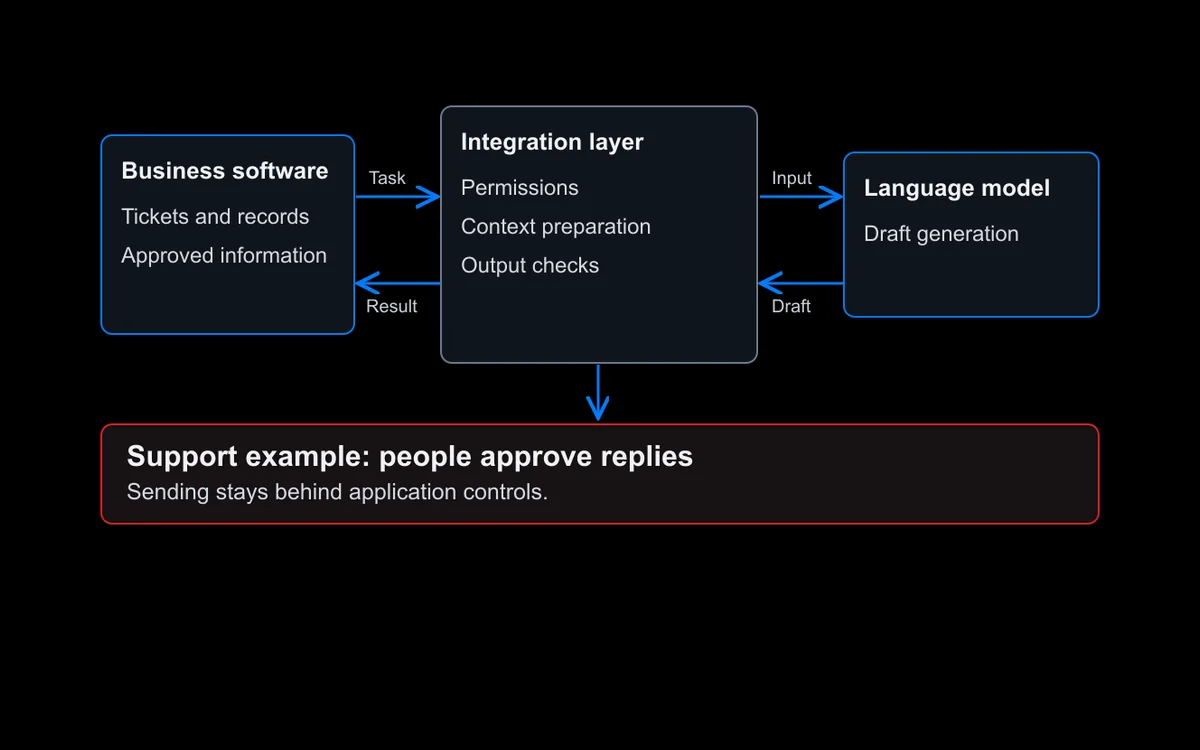
For the application work around retrieval, our article on generative AI integration explains the data connections, approval controls, and testing to plan before development.
RAG as a Service vs. the Alternatives
The following are three common approaches, not mutually exclusive categories. A provider or in-house team can also build on a managed platform. The right one depends on your team’s existing capacity, your timeline, and how specific your use case is; none of the three is categorically fastest, cheapest, or most controllable in every situation.
| Approach | Control | Time to a working system | Best fit |
|---|---|---|---|
| Build in-house | Full control over architecture and data, within the limits of whichever underlying models, licenses, and infrastructure you choose | Depends heavily on your team's existing expertise, integrations already in place, and how ready your data is; can be the slowest path without those already in place | Teams with in-house AI or engineering capacity who want to own the system long term |
| Pre-built tools (for example Microsoft Copilot Studio, Amazon Q Business) | Limited to what the platform and its connectors allow | Can shorten initial setup when the connectors, controls, and workflow you need are already supported | Use cases the platform's own connectors can reach, whether your data sits natively inside that ecosystem or is pulled in through an external connector |
| RAG as a service | Shared, defined by the engagement | Depends on scope, data readiness and provider availability; external expertise may reduce setup work | Teams with a specific use case, non-standard data, or no in-house ML team, who still want a system built around their actual data |
Approach
Build in-house
- Control
- Full control over architecture and data, within the limits of whichever underlying models, licenses, and infrastructure you choose
- Time to a working system
- Depends heavily on your team's existing expertise, integrations already in place, and how ready your data is; can be the slowest path without those already in place
- Best fit
- Teams with in-house AI or engineering capacity who want to own the system long term
Approach
Pre-built tools (for example Microsoft Copilot Studio, Amazon Q Business)
- Control
- Limited to what the platform and its connectors allow
- Time to a working system
- Can shorten initial setup when the connectors, controls, and workflow you need are already supported
- Best fit
- Use cases the platform's own connectors can reach, whether your data sits natively inside that ecosystem or is pulled in through an external connector
Approach
RAG as a service
- Control
- Shared, defined by the engagement
- Time to a working system
- Depends on scope, data readiness and provider availability; external expertise may reduce setup work
- Best fit
- Teams with a specific use case, non-standard data, or no in-house ML team, who still want a system built around their actual data
Pre-built platforms are not necessarily limited to data already inside their own ecosystem: for example, Microsoft Copilot Studio can connect to specified public websites and enterprise data through connectors,Source [2] and Amazon Q Business supports connectors to third-party sources such as SharePoint, Box, and Google Drive, plus a custom connector option.Source [3] The real boundary is what each platform’s connectors actually support, not a blanket ecosystem restriction, so check current connector coverage for your specific sources before ruling a platform in or out.
AWS also describes Amazon Quick Suite as the next evolution of Amazon Q Business, while confirming that existing Q Business customers can continue using their current service. Check current availability and product scope when comparing offers.Source [3]
None of these is categorically better. A pre-built tool can be the right call for a use case its connectors can reach, whether the data lives natively in that platform or is pulled in externally. Building in-house makes sense when the system is core to your product, you already have the team to own it long term, and your data and integrations are ready to support that. RAG as a service tends to make sense in between those two: when your data does not fit neatly into a pre-built platform’s connectors, or when your use case is specific enough that a general tool cannot cover it well, but building and staffing an ML team yourself is not the right trade-off.
How a RAG as a Service Engagement Typically Unfolds
Providers vary in exact process, and this is an illustrative sequence rather than SensViz’s own established process. The phases below provide a practical framework for discussing scope and responsibilities.

Discovery and scoping. The provider works with you to define the specific use case, the data sources involved, and what a working system needs to do. This is also where questions like data sensitivity and access requirements get raised, not after the build starts.
Data connection and retrieval setup. Your approved documents and data sources get structured and indexed so the system can search them effectively. This step is often where the real engineering effort goes, since messy or inconsistent source data makes retrieval harder no matter how good the underlying model is.
Build and evaluation. The provider configures the retrieval and generation components and tests the system against real questions, checking not just whether it answers, but whether the answer is actually supported by the retrieved sources. Acceptance criteria for this stage should be agreed and tested against before launch, not decided informally afterward.
Launch and handover. The system goes live for its intended users, usually starting with one use case or team rather than a company-wide rollout on day one. If the engagement was scoped as build-only, this is also the handover point: confirm delivery of the agreed code, configuration, documentation and account access. Ownership and third-party licensing should follow the contract.
Ongoing operation, only if included. For engagements that extend beyond a one-time build, this covers monitoring quality over time, updating the knowledge base as source documents change, and adjusting retrieval as usage patterns reveal gaps. If ongoing operation was not part of the scope, these responsibilities sit with your team from handover onward.
A Buyer Self-Assessment
Before comparing providers, it helps to answer a few questions honestly about your own situation.
How sensitive is the data the system would need access to? More sensitive data raises the bar on what you should ask a provider about handling and access control, covered below.
How often does your knowledge base change? A system built around documents that update weekly needs a different maintenance plan than one built around a policy manual that changes twice a year.
Do you have in-house engineering or ML capacity? If you do, building in-house, or asking a provider for RAG development services without the ongoing operation piece, may fit better than a full RAG as a service arrangement.
What is your realistic timeline, and how ready is your data? A narrow deadline and messy source data both push against a from-scratch in-house build.
When RAG as a Service Is Probably Not the Right Fit
No single option fits every situation, and there are a few cases where this one is not the best answer.
If your use case is simple and your data already lives inside a platform like Microsoft 365 or Google Workspace, a pre-built tool may get you most of the value with far less setup. If the system is a core part of your product, plan how you will retain architectural control and the expertise to maintain it. You can build internally or commission an external team to deliver it under agreed ownership and handover terms. And if your source data is too inconsistent, incomplete, or poorly organized to search reliably, that is a data-readiness problem no RAG implementation, service or otherwise, will fix on its own. Cleaning up the underlying data has to come first.
Questions Worth Asking RAG as a Service Providers
These are useful to ask any RAG as a service provider you are evaluating, not just SensViz. Treat the answers as responsibilities to divide clearly between you and the provider, not items to hand over entirely while your team only reviews outputs afterward.
What will you test before launch, and how will we know it passed? Ask for representative test questions drawn from your real use cases and agreed acceptance criteria before work begins, not just a demo at the end. Retrieval quality, factual accuracy, citation support, and how the system handles questions it cannot answer are different things, worth checking separately rather than as one bundled sign-off.
How is accuracy or quality measured on an ongoing basis, and how will we know if the system is working? For ongoing engagements, ask how the provider evaluates retrieval quality and answer accuracy after launch. For a build-only project, agree how those checks transfer to your team.
Will the system respect who is allowed to see what? If different users should see different sources, ask how the system enforces that at the retrieval step, not only at the interface level, and ask whether it has been tested against a user attempting to surface information they should not have access to.
What happens when a source document is updated, deleted, or goes stale? Ask how the system tracks changes to source data. An answer that cites a removed or outdated document is a real failure mode worth testing for, not an edge case to assume away.
How is our data handled, and is an NDA available? SensViz can sign an NDA before you share confidential documents or sensitive project information. Ask any provider what their own policy is rather than assuming, and treat an NDA as one part of a data-handling conversation, not a guarantee of security by itself. Separately, ask where data is stored and whether the provider or any underlying model provider retains it, and under what retention period.
Are we locked into a specific model or vector database, or can components be replaced later? Model and database choices are agreed around the project's requirements. Where portability matters to you, raise it early so it can be addressed in the architecture and handover plan, since changing providers later can mean integration changes, data migration, re-embedding, and retesting. Also confirm what you receive at handover: source code, configuration, documentation, and account ownership for any infrastructure used, plus what export process exists if you later change providers.
Who is responsible if something breaks or a source goes stale after launch? If the engagement includes ongoing operation, get a named point of contact and a response expectation in writing. If it does not, confirm explicitly that this becomes your team's responsibility from handover.
What happens if we want to end the engagement or bring the work in-house? Agree what data and configuration can be exported, which accounts and access rights transfer, what retained copies will be deleted, and whether transition support is included. Record any third-party licensing limits before signing.
Frequently Asked Questions
A few additional questions come up often enough to answer directly here.
Is RAG as a service the same as fine-tuning a model?
No. Fine-tuning changes a model's underlying weights through additional training. RAG does not inherently require retraining the generation model at all: it connects an existing model to your data at the time of the question. Some solutions combine the two, pairing retrieval with a fine-tuned component, but RAG is the technical approach; 'as a service' describes how that capability is delivered.
Can we start small and expand later?
Yes, in most engagements. A common approach is to start with one knowledge base or use case, confirm retrieval quality and adoption in practice, and then expand to additional data sources, teams, or use cases once that first phase is working well. Discuss the phased approach with your provider before scoping the initial engagement.
What happens to our data?
This depends on the provider's specific policies on storage location, retention, confidentiality, and whether your data is ever used to train or fine-tune models serving other clients. None of this should be assumed: confirm each point directly with the provider and get it in writing before sharing sensitive documents or systems access.
Is this only useful for large enterprises?
No. RAG as a service can be a better fit for smaller teams when external support reduces the need to recruit a dedicated ML team for one use case. A well-scoped engagement matches the size of the problem, not the buyer, so a narrow use case can be a reasonable starting point regardless of company size.
Do we need our own AI or engineering team to work with a RAG as a service provider?
Not necessarily, depending on scope. You will still need someone internally who can define the use case, approve data sources, and review outputs, even without a dedicated ML team. Larger or more technical engagements may benefit from an internal contact who understands your existing systems and data, though that person does not need to be an AI specialist.
Where RAG as a Service Fits at SensViz
SensViz builds custom RAG applications as part of its Generative AI and LLM Solutions work. Hosting, handover, and any ongoing support should be agreed in the project scope with your delivery team, rather than assumed from this guide. For a technical look at how these systems are actually architected, see the RAG architecture and retrieval quality guide.
If you are weighing whether RAG as a service fits your team, get in touch to talk through your specific use case.
Sources
- Amazon Web Services, “What is Retrieval-Augmented Generation (RAG)?” (opens in a new tab)
- Microsoft, “Knowledge sources in Microsoft Copilot Studio” (opens in a new tab)
- Amazon Web Services, “Amazon Q Business connectors” (opens in a new tab)
The comparison framework, engagement process, and buyer questions above are original editorial synthesis, not sourced from these references. The citations above support only the specific factual claims they are attached to: the definition of RAG, and named connector capabilities of Microsoft Copilot Studio and Amazon Q Business.