

Generative AI & LLMs
Best AI Evaluation Tools for Production: How to Choose
Written by Tehreem FatimaReviewed by Umaid Asim
Published 8 min read

An AI assistant can give a convincing answer and still use the wrong source, call the wrong tool, or fail to complete the task. Choosing evaluation software starts with deciding which of those failures your team needs to see.
The best AI evaluation tools for production depend on your workflow. Braintrust and Langfuse suit teams connecting experiments with production feedback; Phoenix is worth considering for trace-led investigation. DeepEval and Promptfoo offer code-first testing workflows, while Ragas is useful when retrieval and answer quality need separate measurement. These are starting points, not exclusive capabilities or a universal ranking.
This comparison covers large language model (LLM) applications, retrieval-augmented generation (RAG), and agents. It excludes general-purpose computer vision and traditional predictive models. It draws on official documentation checked on 14 September 2026. We have not run a head-to-head performance benchmark.
Which AI evaluation tools should you shortlist?
Start with the work your team needs to do regularly. A framework that runs tests from code and a shared evaluation platform solve overlapping, but different, problems.
| Tool | A useful starting point when you need | Check before adopting |
|---|---|---|
| Braintrust | Shared experiments and production scoring | Enterprise requirements for self-hosting |
| Langfuse | Tracing, datasets and evaluation in one workflow | Hosting operations and feature availability |
| Arize Phoenix | Trace inspection and experiment analysis | Elastic License 2.0 terms |
| DeepEval | Python evaluation tests alongside application code | Judge configuration and reporting workflow |
| Ragas | Separate retrieval and answer-quality metrics | Required inputs for each metric variant |
| Promptfoo | Configuration-driven comparisons and red-team tests | Local versus hosted data flows |
A starting point for a shortlist, not a ranking. Each row links to the supporting documentation in the sections below.
Scroll the table sideways to see every column.
The sections below explain these recommendations and link to the supporting documentation. Prefer the tool that fits your existing workflow over a longer feature list your team will not use.
Six tools and where each fits
Each profile explains where the tool fits and what to check before adopting it.
Braintrust for shared experiments and production feedback
Braintrust brings datasets, scorers, experiments and online scoring into a shared workflow. Teams can compare changes before release, then use selected production traces to improve their test cases. Its documentation distinguishes mutable playground runs from experiments that preserve a snapshot. That distinction matters when someone asks which configuration produced a result.Source [1]
Shortlist it when engineers and product reviewers need a common place to examine results. Check deployment requirements early: its self-hosting option is Enterprise-only and separates a customer-operated data plane from a managed control plane. Do not assume it means running every component independently.Source [2]
Langfuse for evaluation connected to application traces
Langfuse supports offline experiments on datasets and online evaluation of live traces (records of an application’s execution) with automated scoring and human annotation. This makes it a useful LLM evaluation platform to consider when debugging and quality review need the same application context. Its documentation also describes continuous integration (CI) checks for detecting regressions against configured thresholds.Source [3]
Evaluate the operational commitment alongside the features. Self-hosting requires infrastructure management; a local Docker Compose setup is not equivalent to a production deployment with backups and availability planning. Confirm which capabilities are included in your chosen deployment and licence.Source [4]
Arize Phoenix for trace-led investigation
Phoenix combines tracing, evaluation, datasets and experiments, using OpenTelemetry and OpenInference instrumentation. It is worth shortlisting when your first question is where a multi-step application went wrong, and you want to connect that investigation with evaluation results.Source [5]
Keep Phoenix separate from Arize’s other commercial offerings when comparing features. Also read its licence rather than treating every downloadable tool as having identical terms: Phoenix uses the source-available Elastic License 2.0, which includes restrictions on providing the software as a managed service. That may matter if you intend to embed it in an offering for customers.Source [6]
DeepEval for Python-first evaluation tests
DeepEval fits teams that want evaluation tests close to their application code. It integrates with Pytest and supports local evaluation, agent trajectories and component-level diagnosis. Its optional integration with Confident AI adds a separate shared platform; distinguish that service from the framework when assessing your requirements.Source [7]
For agents, its tool-correctness metric can compare actual calls with expected tools, including configured argument or output checks. Choose criteria that reflect valid behavior: forcing one exact tool sequence can reject a different but acceptable solution. Judge-model settings and cloud reporting still need a data-handling review.Source [8]
Ragas for understanding RAG quality
Ragas is a useful option when a single answer score hides the cause of a failure. Its metrics cover questions such as whether relevant context ranks well and whether answer claims are supported by that context. Metric variants require different inputs, so check whether you need reference answers, retrieved passages or other labels before planning the dataset.Source [9]
Faithfulness is not the same as factual truth: an answer can accurately repeat an outdated document. Ragas defines faithfulness in relation to the retrieved context.Source [10] For the architectural background, see SensViz’s RAG architecture and retrieval quality guide.
Promptfoo for repeatable comparisons and red-team testing
Promptfoo offers configuration-driven evaluation and red-team testing. It is a practical candidate when engineers want to compare prompts or models and keep test definitions with the application. Treat security tests as evidence about tested scenarios, not proof that the application is secure.Source [11]
Read its data-flow documentation before using confidential examples. Target evaluation runs locally against your configured provider, but test generation and grading can use hosted services depending on configuration. Some operations remain remote-only. “Local tool” therefore does not mean “nothing leaves our environment.”Source [12]
What matters in current production evaluation?
Modern applications need checks beyond the final paragraph an LLM writes. Agent evaluations can inspect tool calls and the resulting application state. A claim that a support ticket was updated is different from evidence that the correct record actually changed. Anthropic’s 2026 engineering guidance distinguishes an agent’s transcript from its outcome and recommends matching graders to the behavior being tested.Source [13]
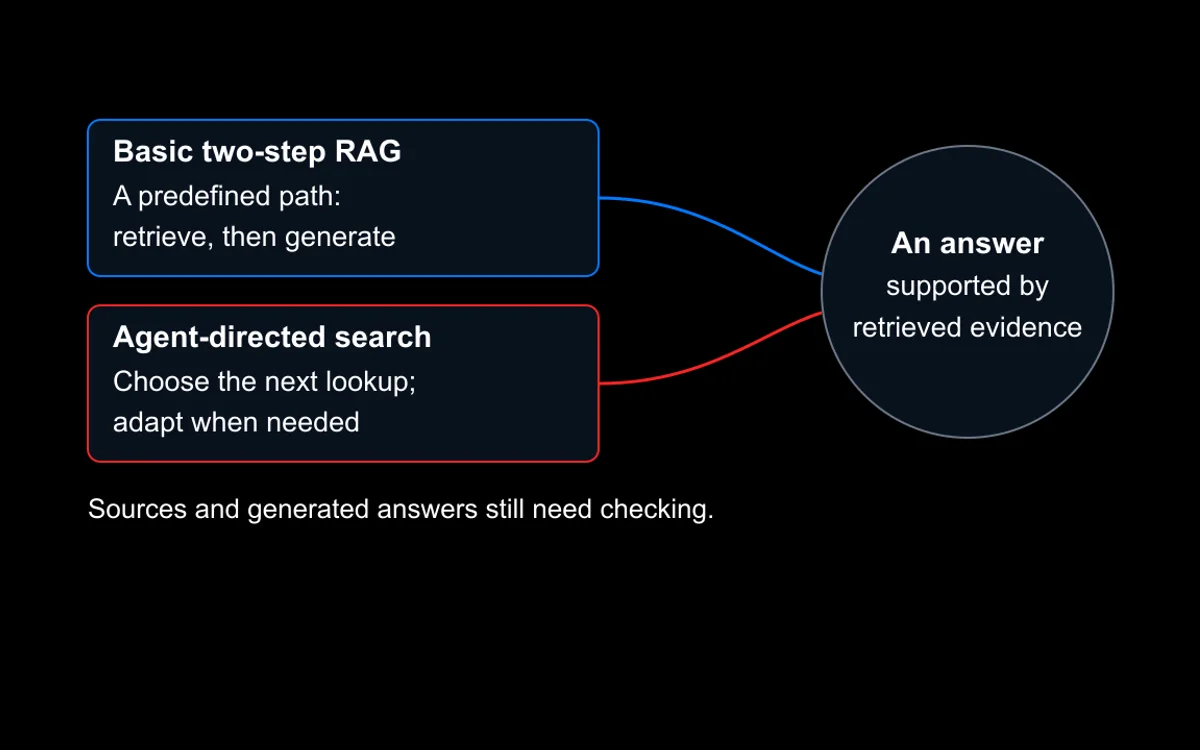
For RAG, select LLM evaluation metrics that separate retrieval quality from answer quality. For agents using tools exposed through the Model Context Protocol (MCP) or other integrations, check permissions and actual outcomes as well as call structure. An available integration is not a guarantee that your particular workflow is covered.
Another capability to examine is the connection between production trace scoring and offline datasets. Braintrust and Langfuse document this feedback workflow. It can make new failure cases easier to investigate, but requires sampling, redaction and someone responsible for reviewing the results. Model-based scoring informs decisions but does not replace business acceptance criteria.

What matters before you commit
Assess candidates against your release criteria, test cases and operating costs.
Define the decision the score must support
Write down what would make your team accept, investigate or reject a change. “Improve answer quality” is too broad. “Avoid inventing a policy exception when the source contains none” gives reviewers a concrete behavior to assess.
Use code checks for properties that can be verified directly, such as a required field or database state. Use a clear rubric where judgment is necessary. Compare LLM-as-a-judge results with human judgments before using them for important release decisions. Anthropic describes combining code, model-based and human graders rather than relying on one scoring method.Source [13]
Compare candidates on the same application
Pilot a small shortlist using the same cases, application version and scoring criteria. Include difficult requests, missing information and failures you already understand. Keep a separate validation set so you do not judge every improvement on examples used to tune it.
Record the model, prompt, dataset and evaluator versions. Fixed test cases make comparisons more useful, but do not make model outputs deterministic. Repeat important cases where variation could change the decision.
Review the full operating cost
The subscription is only part of the cost. Estimate judge-model calls, stored traces, human annotation, integration work and infrastructure support. Check retention, access controls, exports and provider data flows before collecting real customer conversations. Ask who will maintain the evaluation suite when prompts, models or source documents change.
Open-source LLM evaluation tools can reduce some adoption barriers, but neither an open licence nor self-hosting removes these responsibilities. Compare the actual licence and deployment, not the label alone.
A practical example of choosing the stack
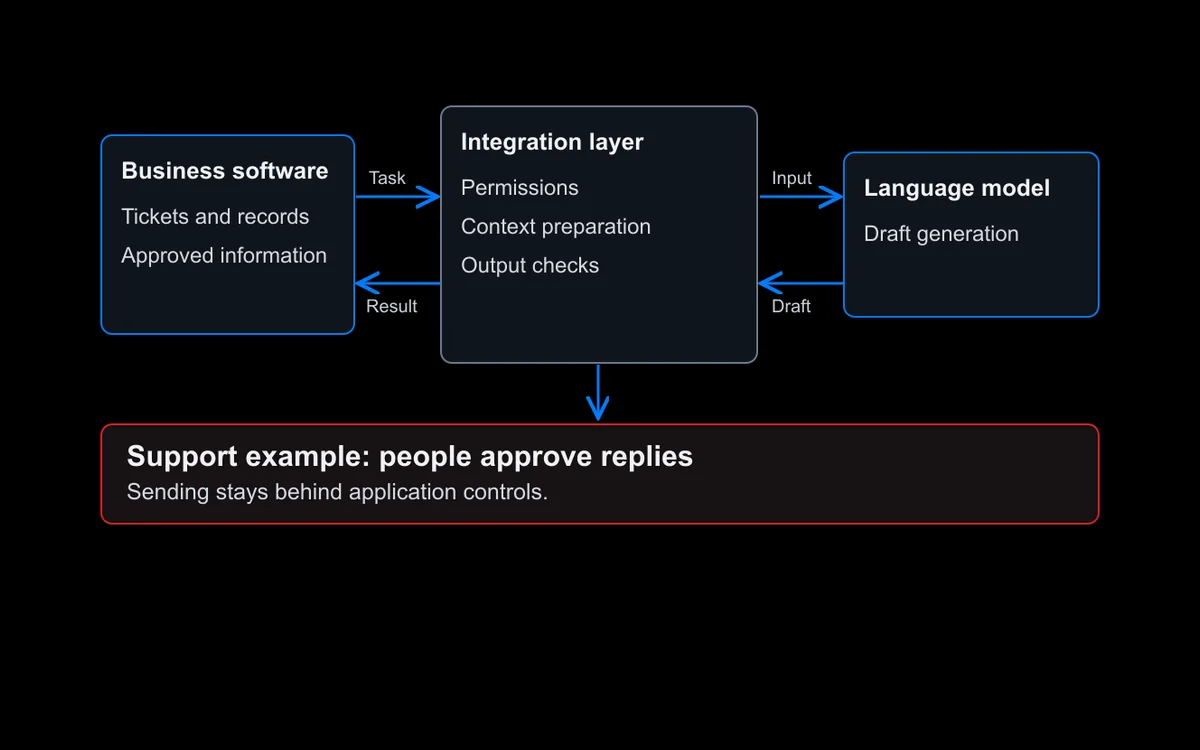
Consider a hypothetical support assistant that retrieves refund rules, drafts a response and can update a ticket after approval. It needs three different kinds of evidence: the right policy was retrieved, the draft respected that policy, and the update affected the right ticket without bypassing approval.
If the main problem is reviewing failures across engineering and support, start by piloting a shared tracing and evaluation platform. If the team already has adequate tracing but needs regression tests in its Python application, a framework such as DeepEval may be the smaller addition. Ragas can help assess retrieval separately; Promptfoo may be useful for adversarial scenarios.
Do not install all six tools by default. Choose one primary workflow, add a specialist evaluator only for a demonstrated gap, and make sure results can be traced back to the same test case. This is an illustrative selection approach, not a measured SensViz client outcome.
Where SensViz can help
Evaluation software cannot decide what success means for your business or fix the application by itself. SensViz’s Generative AI and LLM Solutions services cover RAG systems, model integration and evaluation against representative tasks. For systems that take actions, its agentic AI development services address workflows, permissions and human oversight.
If you are choosing between AI evaluation frameworks or improving an existing application, discuss your workflow with SensViz. Bring examples of successful and failed outputs, the systems involved and your data constraints. Those details are a better starting point for selecting the best AI evaluation tools for production than a generic leaderboard.
Frequently asked questions
Two questions help clarify what evaluation can and cannot do.
Do we need both evaluation and observability?
Often, yes, but not necessarily as separate purchases. Observability records what happened; evaluation assesses it against criteria. Several tools combine them. Check whether your existing tracing setup can support the evaluation workflow before adding another platform.
Can an evaluation score guarantee that an AI application is ready?
No. A score reflects the cases, criteria and evaluator used. Release decisions also need risk-appropriate human review, operational checks and monitoring. Treat a passing score as evidence for a decision, not a guarantee about unseen requests.
Sources
- [1] Braintrust: Evaluation workflow (opens in a new tab)
- [2] Braintrust: Self-hosting (opens in a new tab)
- [3] Langfuse: Evaluation overview (opens in a new tab)
- [4] Langfuse: Self-hosting (opens in a new tab)
- [5] Arize Phoenix: Documentation (opens in a new tab)
- [6] Arize Phoenix: Licence (opens in a new tab)
- [7] DeepEval: Quickstart (opens in a new tab)
- [8] DeepEval: Tool correctness (opens in a new tab)
- [9] Ragas: Available metrics (opens in a new tab)
- [10] Ragas: Faithfulness (opens in a new tab)
- [11] Promptfoo: Introduction (opens in a new tab)
- [12] Promptfoo: Data handling and privacy (opens in a new tab)
- [13] Anthropic: Demystifying evals for AI agents (opens in a new tab)