

Generative AI & LLMs
Agentic Search vs. RAG: What's Different, and When Each One Makes Sense
Written by Tehreem FatimaReviewed by Umaid Asim
Published 6 min read

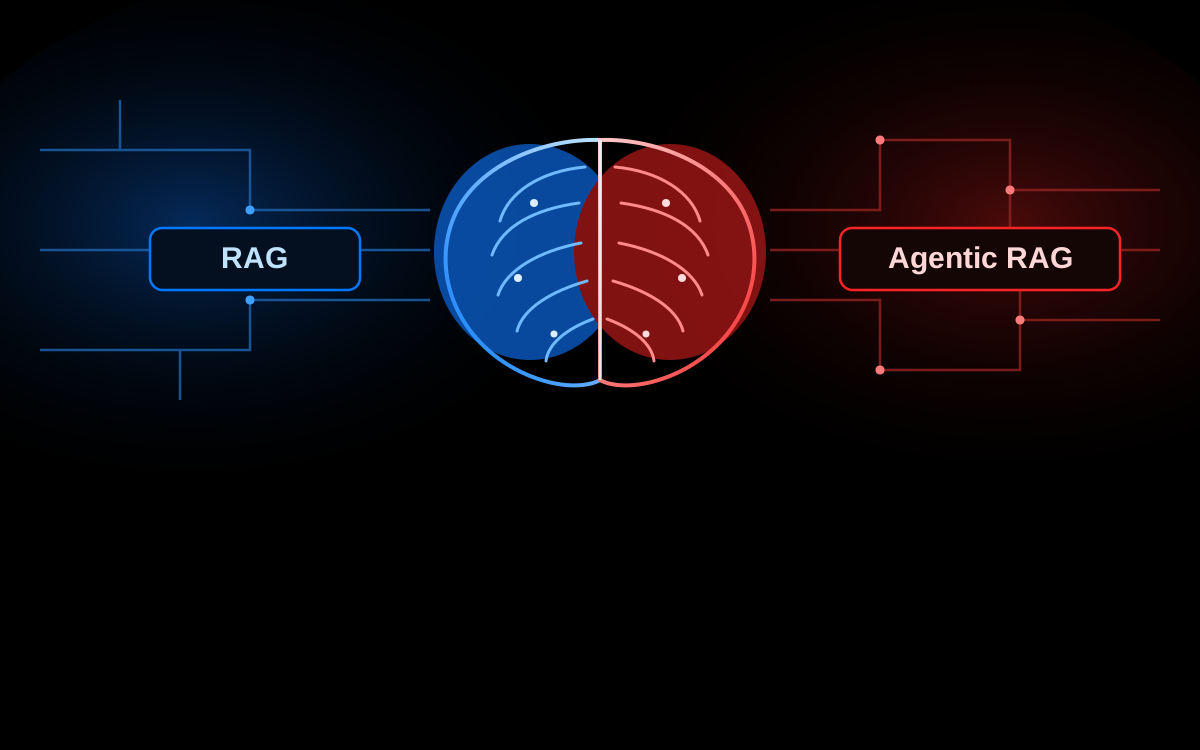
Agentic search vs RAG is not a choice between the live web and private documents. RAG supplies retrieved evidence to a language model to help it answer. Agentic search gives an agent some control over what to search, which tool to use and whether another lookup is needed. They can overlap: agentic retrieval can be part of a RAG application.Source [1]
For a useful comparison, this article contrasts a basic two-step RAG workflow with agent-directed search. Choose between them by testing the questions your application must answer, not simply by checking whether the information is internal or external.
A Quick Recap Of RAG
Retrieval-augmented generation (RAG) connects a language model to information outside its trained knowledge. In a basic two-step workflow, retrieval supplies relevant context before the model generates an answer. A vector index is common, but it is not mandatory: an existing database or documentation system can also supply context.Source [1]
We cover the mechanics of a document-based pipeline, including chunking, embeddings and evaluation, in our guide to RAG architecture and retrieval quality.
A predefined retrieval path is easier to inspect than an open-ended search process. But simple does not mean incapable of checks. Developers can add source-date filters, evidence checks, answer validation or an explicit refusal when evidence is missing. RAG describes how an answer uses retrieved information; it does not require the system to accept every passage it finds.
What Agentic Search Actually Means
Agentic search lets an AI agent make retrieval decisions during the task. It may split a question, choose a search tool, inspect results and revise its plan. The available sources can include internal documents, databases, APIs and public websites. For example, Microsoft’s agentic retrieval documentation covers both proprietary and external content, with indexed or remotely accessed sources.Source [2]
Consider an illustrative procurement question: “Which approved supplier can provide this part by Friday?” The system may need to check supplier approval records, stock availability and delivery estimates. If the first result lacks a delivery date, an agent could request that specific information next. Nothing about this example requires a public web search.
A predefined workflow could handle the same question if the lookups and decision rules are already known. Agentic behaviour becomes worth testing when the next useful lookup depends on what earlier results reveal. It adds flexibility, but also more opportunities for irrelevant searches, misread evidence and unnecessary tool calls.
RAG And Agentic Search, Side By Side
Keep two decisions separate: where the evidence comes from and how the retrieval steps are chosen. Both approaches below can access approved internal or external sources. The comparison is a starting point for an implementation, not a universal definition of every RAG system.

| Aspect | Basic two-step RAG | Agent-directed search |
|---|---|---|
| Data source | Approved documents, databases, APIs or web sources, as configured. | The same source types; the agent chooses among its allowed tools. |
| Freshness | Depends on source updates, retrieval settings and refresh schedules. | Still depends on source quality and dates; searching now does not guarantee fresh evidence. |
| Control | Retrieval precedes generation along a predefined path. | The agent can plan lookups, assess gaps and change the next search. |
| Speed and cost | Often easier to budget when the number of model calls is bounded. | More calls can increase cost and delay; actual results depend on the workload and limits. |
| Best fit | Questions with a known evidence path and a repeatable answer format. | Questions where useful follow-up searches depend on earlier findings. |
| Main risk | Missing or poorly retrieved evidence can undermine the answer. | Wrong tool choices, faulty evaluations or excessive searching can undermine the answer. |
Data source
- Basic two-step RAG
- Approved documents, databases, APIs or web sources, as configured.
- Agent-directed search
- The same source types; the agent chooses among its allowed tools.
Freshness
- Basic two-step RAG
- Depends on source updates, retrieval settings and refresh schedules.
- Agent-directed search
- Still depends on source quality and dates; searching now does not guarantee fresh evidence.
Control
- Basic two-step RAG
- Retrieval precedes generation along a predefined path.
- Agent-directed search
- The agent can plan lookups, assess gaps and change the next search.
Speed and cost
- Basic two-step RAG
- Often easier to budget when the number of model calls is bounded.
- Agent-directed search
- More calls can increase cost and delay; actual results depend on the workload and limits.
Best fit
- Basic two-step RAG
- Questions with a known evidence path and a repeatable answer format.
- Agent-directed search
- Questions where useful follow-up searches depend on earlier findings.
Main risk
- Basic two-step RAG
- Missing or poorly retrieved evidence can undermine the answer.
- Agent-directed search
- Wrong tool choices, faulty evaluations or excessive searching can undermine the answer.
The table describes typical design tradeoffs, not measured performance. A slow API can delay either architecture. Search results can also contain outdated pages or conflicting claims, so “live” should never be treated as a quality guarantee.
Where Agentic RAG Fits In
Agentic RAG uses agent-directed retrieval to supply evidence for generated answers. It is not restricted to a company’s own index. When comparing RAG vs agentic RAG, the practical question is whether adaptive retrieval improves the application enough to justify the additional complexity—not whether one uses private data and the other uses the web.
Query planning breaks a complex question into smaller retrieval goals instead of treating it as one search. A question like “why is single sign-on failing for a subset of users?” could require separate lookups of error codes, identity-provider configuration and recent deployment notes. Independent lookups may run in parallel; dependent ones need the earlier results first. Microsoft’s implementation, for example, can plan and run multiple subqueries in parallel.Source [2]
Tool use beyond retrieval lets the agent call more than a vector search. It can query a database, run a verification check or call an internal API, choosing an allowed tool for the question instead of defaulting to document search every time.
Iterative evaluation lets the system reconsider whether its evidence covers the question. If not, it may rewrite the query or check a different source. This is an attempted quality check, not proof of correctness: a model can misjudge its own results. Define a maximum number of searches, a time or cost budget, and a path to explain uncertainty or ask a person for help. Bounded execution and human oversight are important agent design controls.Source [3]
How To Decide Which One You Need
Start with the simplest approach that meets the task. Anthropic similarly recommends adding agentic complexity only when it is needed.Source [3] Several relevant documents do not, by themselves, justify an agent: a well-configured retriever can return multiple passages in one step.
Before changing architecture, compare a basic workflow and an agentic version on the same representative questions. Include straightforward lookups, ambiguous requests, conflicting sources and questions that cannot be answered from the available evidence. Judge both against answers checked by someone who understands the subject.
- Evidence quality: Does the response answer the actual question, and do its cited sources support its claims?
- Failure handling: Does it flag missing information, respect retry limits and escalate when necessary?
- Operating cost: What are the cost per completed task, tool-call count and typical and slow-case response times?
- Access and safety: Does it retrieve only information the user may access and treat instructions inside retrieved content as untrusted? OWASP identifies such indirect prompt injection as a material risk.Source [4]
If the adaptive version produces a meaningful improvement on difficult questions, consider routing those questions to it while keeping routine lookups on a simpler path. If both versions fail because documents are missing or outdated, fix the sources first. More searches will not create evidence that does not exist.
SensViz builds RAG search, knowledge assistants and LLM applications with approved sources, evaluation and access controls. If you are weighing this tradeoff for a specific project, our Generative AI and LLM development team can help you scope and build it, or you can Get in touch directly.
Sources
- [1] LangChain. Retrieval (opens in a new tab). Accessed 13 September 2026.
- [2] Microsoft Learn. Agentic retrieval overview (opens in a new tab). Accessed 13 September 2026.
- [3] Anthropic. Building effective agents (opens in a new tab). Accessed 13 September 2026.
- [4] OWASP. LLM01:2025 Prompt Injection (opens in a new tab). Accessed 13 September 2026.