Generative AI & LLMs
PoC vs MVP vs Prototype for AI Products: What Each One Proves
Written by Tehreem FatimaReviewed by Umaid Asim
Published 15 min read

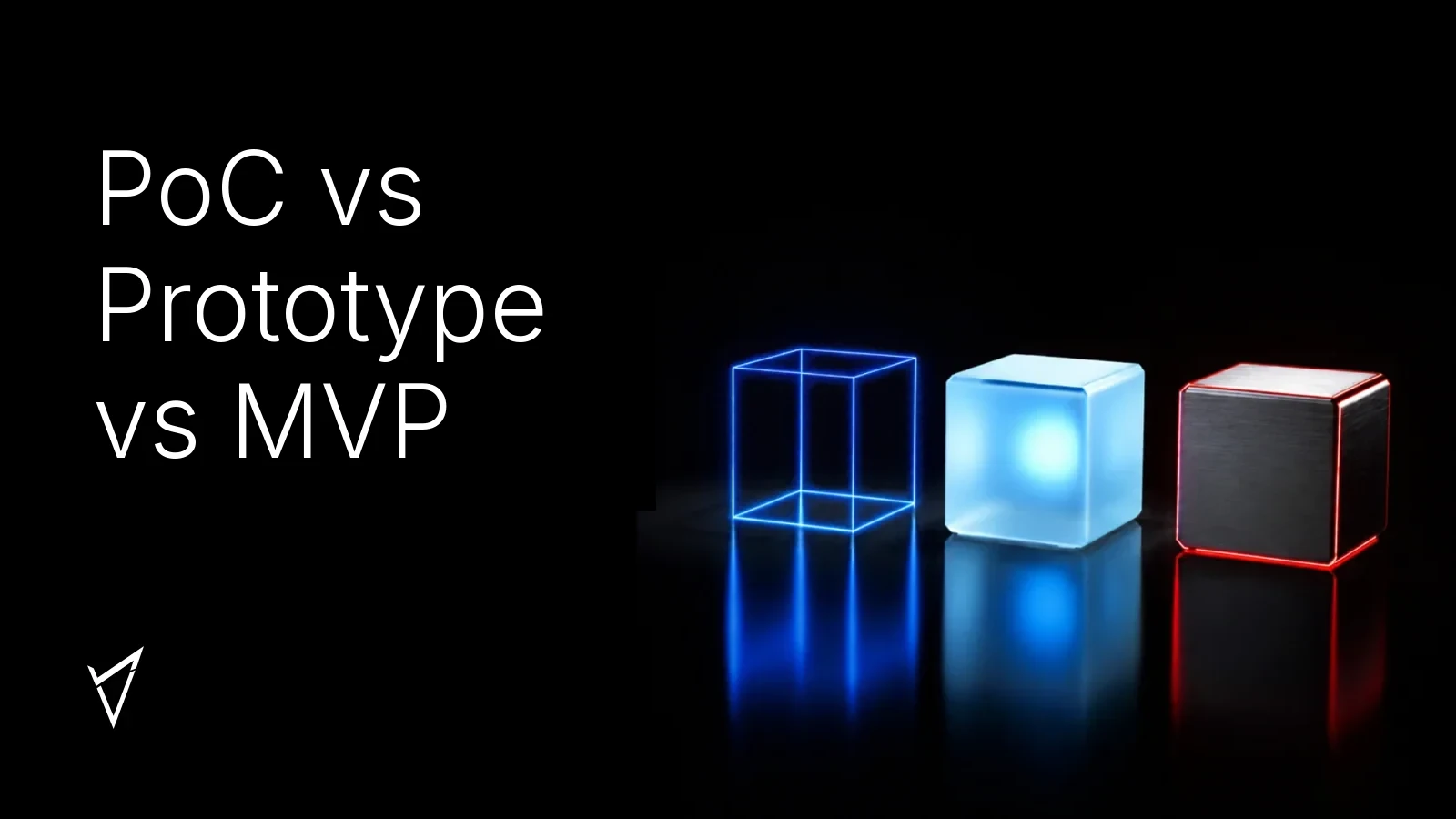
A proof of concept (PoC) tests whether an idea can work technically. A prototype tests whether people understand and want the experience. A minimum viable product (MVP) is the first real version people rely on, released to learn whether it is worth growing. For AI products, each stage must also measure how often the model gets things right.
The PoC vs MVP question is harder with AI than with ordinary software. A normal feature either works or it does not. An AI feature can answer well in ten demos and get the eleventh wrong, and it can cost more per use than anyone planned. Teams that treat a good demo as proof end up skipping a stage they needed, or paying for one they did not.
This article is for founders, product leads and operations managers deciding what to build next for an AI idea. It ends with a simple way to choose that next step.
What Is the Difference Between a PoC, a Prototype and an MVP?
The difference is the question each one answers. A PoC asks whether the idea can work. A prototype asks how people would use it. An MVP asks whether real users will keep using it once it is live. The three also differ in who sees them, how much gets built, and what happens to the work afterwards.

| Aspect | Proof of concept (PoC) | Prototype | Minimum viable product (MVP) |
|---|---|---|---|
| Question it answers | Can this work on our data, well enough and cheaply enough? | Will people understand it and want to use it? | Will real users adopt it and keep using it? |
| Who sees it | The project team and whoever funds the next step | A small group of target users in test sessions | Real users, often early customers or one internal team |
| What gets built | Only the risky core, often with no interface | The experience, with the AI faked or only partly real | A working product with the smallest useful set of features |
| AI evidence it should produce | Scores on an evaluation set against pass marks set in advance | How users react to wrong or uncertain answers | Quality, cost and failure rates on live use |
| What happens to it afterwards | Usually set aside; the test cases and findings are kept | Design decisions carry forward; the code rarely does | Becomes the base of the product |
| What it does not prove | That anyone wants it | That the model can deliver what the prototype showed | That it will hold up at full scale without more work |
Question it answers
- Proof of concept (PoC)
- Can this work on our data, well enough and cheaply enough?
- Prototype
- Will people understand it and want to use it?
- Minimum viable product (MVP)
- Will real users adopt it and keep using it?
Who sees it
- Proof of concept (PoC)
- The project team and whoever funds the next step
- Prototype
- A small group of target users in test sessions
- Minimum viable product (MVP)
- Real users, often early customers or one internal team
What gets built
- Proof of concept (PoC)
- Only the risky core, often with no interface
- Prototype
- The experience, with the AI faked or only partly real
- Minimum viable product (MVP)
- A working product with the smallest useful set of features
AI evidence it should produce
- Proof of concept (PoC)
- Scores on an evaluation set against pass marks set in advance
- Prototype
- How users react to wrong or uncertain answers
- Minimum viable product (MVP)
- Quality, cost and failure rates on live use
What happens to it afterwards
- Proof of concept (PoC)
- Usually set aside; the test cases and findings are kept
- Prototype
- Design decisions carry forward; the code rarely does
- Minimum viable product (MVP)
- Becomes the base of the product
What it does not prove
- Proof of concept (PoC)
- That anyone wants it
- Prototype
- That the model can deliver what the prototype showed
- Minimum viable product (MVP)
- That it will hold up at full scale without more work
Many AI projects add a fourth step, the pilot, where a limited group uses a working system for a set period. Our guide to scoping and judging an AI proof of concept sets the pilot alongside the other three.
What Is a Proof of Concept (PoC) in AI?
A proof of concept in AI is a short, controlled test of one specific task on your real data. It checks whether a model can do the task at a quality, speed and cost you can accept. It usually has no polished interface and no outside users. It ends in a decision: build it, change the approach, or stop.
What makes an AI PoC different is that a single successful run proves very little. OpenAI's evaluation guide puts it plainly: "Models sometimes produce different output from the same input" Source [5]. The guide adds that this makes traditional software testing insufficient on its own. So an AI PoC is judged on an evaluation set: a fixed group of real cases with agreed correct answers, scored the same way on every run.
The cases should look like the work the product will actually do. Anthropic's guidance on building evaluations says to "Design evals that mirror your real-world task distribution" Source [6], edge cases included. The same guidance lists latency and price among the success criteria to measure Source [6]. A PoC that measures only quality tells you nothing about whether the product is affordable to run.
A PoC can also come back with "no". That is a useful result if it arrives early. It saves a team from building screens, integrations and a launch plan around a model that cannot do the job. Fossilite's guide to testing an AI solution before you commit walks through running one in six steps.
What Is a Prototype?
A prototype is a model of the product experience that people can try before the real product exists. It can be a clickable mockup or a working front end. Its job is to show whether people understand the product and want what it does, not whether the technology underneath works.
Prototypes vary in how real they feel. Nielsen Norman Group describes fidelity as how closely a prototype matches the look and feel of the final system Source [2]. A low-fidelity prototype might be a set of static screens. A high-fidelity one looks and behaves almost like the finished product.
For AI products, a prototype does not need a working model at all. In a Wizard of Oz test, a person writes the responses behind the scenes while the user interacts with what looks like the finished system. Nielsen Norman Group says the method "is particularly useful for testing AI-based systems" Source [2], because a team can test the experience before building the AI. Google's People + AI Guidebook also suggests a Wizard of Oz test to see how people feel about a task being automated Source [3].
An AI prototype should also test what happens when the AI is wrong. Show users an answer with its source, a low-confidence answer, and a plain "I don't know". Then watch which ones they trust, and whether they spot and fix the mistakes. People respond to an AI product partly through how it fails, and a prototype is the cheapest place to learn that.
The limit is that the person behind the curtain is usually better than the model. A Wizard of Oz prototype says nothing about error rates, response time or running cost. Those still need a PoC.
What Is a Minimum Viable Product (MVP)?
A minimum viable product (MVP) is the smallest version of a product that real users can rely on, released to learn whether it is worth building further. It is live, supported and measured. For an AI product, that means it also needs ongoing evaluation, monitoring and a way for people to report or correct wrong outputs.
Eric Ries, who popularized the term, defines the MVP by what it teaches: the version that collects the "maximum amount of validated learning about customers with the least effort" Source [1]. In the same post he warns that the MVP, despite its name, is not about making minimal products. It is the least you can build to learn something real from customers.
An AI MVP has to keep proving what the PoC proved, because the conditions change once real users arrive. Users phrase things differently from test cases, data drifts, and prompts and models get updated. OpenAI recommends evaluating early and often, running evaluations on every change, and using human feedback to calibrate automated scoring Source [5]. Google Cloud's MLOps guidance warns that models can decay in more ways than ordinary software Source [8]. Teams need to track their data and monitor how the model performs live Source [8].
Plan the MVP's controls before launch. Decide what the AI may do on its own, which outputs a person reviews, what gets logged, and how users flag a bad answer. Those controls are part of the minimum, not extras for later.
PoC vs MVP: The Difference That Matters Most
The difference between a PoC and an MVP is the risk each one removes and who sees it. A PoC removes technical risk inside the team: can the model do the task? An MVP removes market risk with real users: will they adopt it? A PoC can be thrown away. An MVP is the first version of the product itself.
A costly mistake in a proof of concept vs MVP decision is shipping the PoC as the MVP. A PoC is built to answer one question fast. It usually skips user accounts, permissions, error handling, logging, privacy controls and cost limits, because none of those affect whether the model can do the task. An MVP needs all of them from day one.
Google Cloud's MLOps guidance makes the same point about AI systems generally: "only a small fraction of a real-world ML system is composed of the ML code" Source [8]. The rest is data pipelines, serving, monitoring and the software around the model. A PoC proves the small part. An MVP has to deliver the whole system, in its smallest useful form.
In an MVP vs PoC decision, the order can also run backwards. If an MVP fails because the AI is not accurate enough, the fix is often a new, narrower PoC on the weak cases, not more features.
Prototype vs MVP, and PoC vs Prototype
The other two pairings are easier to confuse because they can look alike. A prototype and an MVP can both have screens, and a PoC and a prototype can both be built in a week. What separates them is still the question being asked.
Prototype vs MVP
A prototype is shown to users in test sessions, and nobody depends on it. An MVP is used for real work or real purchases, so it has to be reliable, secure and supported. If a prototype breaks, you learn something. If an MVP breaks, a customer or colleague is let down. For AI, a prototype can fake the model, but an MVP cannot.
PoC vs Prototype
A PoC tests the engine and a prototype tests the dashboard. The PoC can have no interface at all, just a script that runs your test cases through a model and scores the results. The prototype can have no real model at all. The two answer separate questions, which is why AI teams often run them at the same time.
What Changes When the Product Is AI
AI does not change what each stage is for, but it adds evidence each stage has to produce. These are the points most PoC vs MVP comparisons skip, and they decide whether an AI product survives the move from one stage to the next.
Outputs Vary, So One Demo Proves Little
A demo shows one good run. AI products need a pass rate across many cases, run more than once. O'Reilly Radar calls the trap "POC purgatory" Source [9]. A demo impresses leadership, then real use shows a system that is inconsistent, slow and prone to making things up. The authors' answer is to let testing, monitoring and evaluation drive decisions from the start Source [9].
Data Readiness Comes Before the PoC
An AI PoC on clean sample data can pass and still fail on the real thing. Gartner predicted in February 2025 that "through 2026, organizations will abandon 60% of AI projects unsupported by AI-ready data" Source [11]. Check that the data exists, can legally be used, and looks like what the product will see in production before a PoC starts. Our AI readiness assessment covers those checks.
Cost Is Per Use, Not Only Per Build
An ordinary software feature usually costs little per extra use. An AI feature is billed per request, and a more capable model or a multi-step agent can multiply that cost. Anthropic recommends "finding the simplest solution possible, and only increasing complexity when needed" Source [7]. Measure cost per task in the PoC, then recheck it at MVP volumes. Our guide to AI agent development cost shows how to work out cost per task.
The Model Underneath Can Change
Most AI products run on a model someone else hosts, and providers retire older models. Anthropic's documentation says plainly: "Requests to retired models fail" Source [12]. It recommends testing your application on the replacement before moving over Source [12]. An evaluation set kept from the PoC is what makes that switch a measured decision instead of a guess.
Sometimes the Best AI Product Has No AI Yet
The first question at any stage is whether AI is needed. Google's Rules of Machine Learning open with "Don't be afraid to launch a product without machine learning" Source [4]. Google's People + AI Guidebook adds that "a rule or heuristic-based solution will work just as well, if not better" in many cases Source [3]. An MVP built on simple rules can collect the data and user feedback a later AI version needs.
One AI Idea Through All Three Stages
Table 2 follows one illustrative product, an assistant that summarizes sales calls and fills in CRM fields, through each stage.
| Aspect | Proof of concept | Prototype | MVP |
|---|---|---|---|
| Question | Can a model pull the right fields from 50 recorded calls? | Will sales reps trust the summaries and fix mistakes? | Do reps keep using it on live calls? |
| What is built | A script that runs call transcripts through a model, with no interface | A clickable CRM screen; an analyst writes the summaries | A working integration for one sales team, with edit tracking and logs |
| Evidence collected | Field accuracy against reps' own notes, cost and time per call | Which fields reps check, what they change, what confuses them | Weekly use, edits per field, cost per call, flagged errors |
| A pass looks like | Scores meet the pass marks written before the test | Reps say they would use it and know how to correct it | Use holds steady and edits stay at an acceptable level |
Question
- Proof of concept
- Can a model pull the right fields from 50 recorded calls?
- Prototype
- Will sales reps trust the summaries and fix mistakes?
- MVP
- Do reps keep using it on live calls?
What is built
- Proof of concept
- A script that runs call transcripts through a model, with no interface
- Prototype
- A clickable CRM screen; an analyst writes the summaries
- MVP
- A working integration for one sales team, with edit tracking and logs
Evidence collected
- Proof of concept
- Field accuracy against reps' own notes, cost and time per call
- Prototype
- Which fields reps check, what they change, what confuses them
- MVP
- Weekly use, edits per field, cost per call, flagged errors
A pass looks like
- Proof of concept
- Scores meet the pass marks written before the test
- Prototype
- Reps say they would use it and know how to correct it
- MVP
- Use holds steady and edits stay at an acceptable level
Which Should Come First: PoC, Prototype or MVP?
Build first whichever stage removes your biggest unknown. If nobody knows whether the model can do the task, start with a PoC. If the technology is proven but the experience is not, start with a prototype. If both are known, go to an MVP. Many AI projects run the PoC and the prototype side by side.

You can skip the PoC when the task is one that current models handle reliably, such as summarizing short documents. Even then, test the model on your own cases before building around it, using a small evaluation set. You can skip the prototype when the product is an internal tool for people who already know the workflow and the interface is simple. You should not skip evaluation at any point.
Order matters most when the risky part is the AI itself. Building screens, integrations and onboarding before a PoC shows the model can do the job is an expensive way to waste an AI budget.
Why AI Projects Stall Between Stages
Many AI projects stall between the PoC and production. S&P Global Market Intelligence surveyed 1,006 respondents in late 2024 and found "the average organization scrapping 46% of their proof-of-concept projects prior to production" Source [10]. The same research found that the share of companies abandoning most of their AI initiatives before production rose from 17% to 42% Source [10].
The pattern behind those numbers is usually a stage that answered the wrong question. A PoC passed on a demo instead of pass marks. A prototype impressed users with answers no model could match. An MVP launched without a cost limit, then became too expensive at real volume. Our AI proof of concept guide goes through the main reasons AI PoCs stall and how to set exit criteria that prevent them. For teams past the first launch, our post on enterprise AI agents covers moving from one pilot to company-wide use.
What to Carry From One Stage to the Next
The code from a PoC or prototype is often thrown away, but the evidence should never be. Carry forward the evaluation set, the baseline you measured, the cost per task, the log of failures, and the design decisions users confirmed. Each stage adds to them, so the MVP launches with test cases built from real use.

The evaluation set matters most. It starts as the PoC's test cases. The prototype adds the way real users phrase things. The MVP adds every live failure someone reports. Run the full set again whenever a prompt, a data source or the model changes. Our post on LLM testing explains how to build and run that test set.
How Much Each Stage Costs
No primary source publishes typical costs for an AI PoC, prototype or MVP, and the ranges on agency pages are their own estimates. What drives the cost is predictable: how ready the data is, how many systems the product connects to, how much evaluation and human review it needs, and what it costs to run per task.
A PoC is usually the cheapest stage because it builds the least. A prototype's cost depends on fidelity; a Wizard of Oz test needs people's time more than engineering. An MVP costs the most, because it needs the software around the model: accounts, permissions, logging, monitoring and support. Our breakdown of what it costs to build an AI chatbot shows how build and running costs add up for one common AI product.
How SensViz Can Help
SensViz is a human-centric AI and software development company. Its discovery work helps teams decide which stage their AI idea needs, then the team builds it. Each engagement starts with discovery, which should produce a clear recommendation, not a commitment to use AI. If a rule, a standard product or an ordinary feature would work better, SensViz says so.
For AI work, SensViz assesses the data and feasibility first and agrees measurable success criteria. It then tests the riskiest assumptions with a prototype and an evaluation on representative cases, before any larger build. After launch, SensViz tracks quality, errors, cost and latency so the system can keep improving. Read more about custom AI development and generative AI development, or see how SensViz scopes an MVP for mobile app development.
If you are deciding between a PoC, a prototype and an MVP for an AI product, talk to the SensViz team about your idea and your data.
Frequently Asked Questions
Quick answers to the questions teams ask most when comparing a PoC vs prototype vs MVP for an AI product.
Can a PoC Become the MVP?
A PoC rarely becomes the MVP directly, because it skips the accounts, permissions, error handling, logging and cost controls an MVP needs. Keep what it proved instead: the evaluation set, the chosen approach, the measured cost per task and the failure log. Some PoC code can be reused, but review it against production standards before it ships.
Is a Pilot the Same as an MVP?
A pilot is not quite the same as an MVP. A pilot gives a working system to a limited group for a set period, often inside one company, to see if it holds up in real work. An MVP is the first release of a product to learn whether users adopt it. For internal AI tools, the two often overlap.
Do You Need All Three Stages?
You do not need all three stages for every AI product. Each stage exists to remove one kind of uncertainty, so skip any stage whose question is already answered. A team with a proven model and a familiar workflow may go straight to an MVP. What should never be skipped is testing the model on your own cases.
Can You Build an AI MVP Without Training a Model?
Many AI MVPs today are built without training a model. They call a hosted model through an API and give it the right instructions and, where needed, your documents through retrieval. Training or fine-tuning comes later, if evaluation shows the simpler approach falls short. Anthropic recommends starting simple and adding complexity only when needed Source [7].
How Long Does an AI MVP Take to Build?
An AI MVP's timeline depends mainly on data readiness, the number of integrations and how much human review the outputs need. SensViz's pricing page says smaller projects or MVPs may take 4 to 6 weeks, while AI systems and complex products may take 2 to 6 months Source [13]. A PoC or a prototype before it usually takes less.
Deciding between a PoC, a prototype and an MVP?
Tell us about your AI idea and your data, and we will help you work out which stage to build first.
Sources
- [1] Eric Ries, Startup Lessons Learned. Minimum Viable Product: a guide (August 2009) (opens in a new tab).
- [2] Nielsen Norman Group. UX Prototypes: Low Fidelity vs. High Fidelity (opens in a new tab).
- [3] Google People + AI Guidebook. User Needs + Defining Success (opens in a new tab).
- [4] Google for Developers. Rules of Machine Learning (opens in a new tab).
- [5] OpenAI API documentation. Evaluation best practices (opens in a new tab).
- [6] Claude Platform Docs. Define success criteria and build evaluations (opens in a new tab).
- [7] Anthropic. Building effective AI agents (opens in a new tab).
- [8] Google Cloud Architecture Center. MLOps: Continuous delivery and automation pipelines in machine learning (opens in a new tab).
- [9] O'Reilly Radar. Escaping POC Purgatory: Evaluation-Driven Development for AI Systems (April 2025) (opens in a new tab).
- [10] S&P Global Market Intelligence. Generative AI shows rapid growth but yields mixed results (October 2025) (opens in a new tab).
- [11] Gartner. Lack of AI-Ready Data Puts AI Projects at Risk (February 2025) (opens in a new tab).
- [12] Claude Platform Docs. Model deprecations (opens in a new tab).
- [13] SensViz. Custom AI and Software Pricing (opens in a new tab).