

Agentic AI
How to Choose an AI Agent Development Company
Written by Tehreem FatimaReviewed by Umaid Asim
Published 11 min read

Choosing an AI agent development company is harder than it looks, partly because most of the advice is written by the companies being chosen. Search for the best or top AI agent development companies and you will mostly find vendors ranking themselves first, directories, and service pages that all promise the same things.
This post takes a different approach. It does not rank anyone. It gives you the questions that separate a team that can put a controlled agent into production from a team that can build an impressive demo, what good and weak answers sound like, the red flags to watch for, how engagements are usually structured, and what drives the cost.
A note on bias: SensViz builds AI agents, so we are one of the companies you might be comparing. Apply these questions to us the same way you apply them to everyone else.
What Makes a Good AI Agent Development Company?
Choose an AI agent development company that first questions whether your task needs an agent, explains which actions the agent may take alone and which need approval, shows how it tests and monitors agents in production, and leaves your team owning the code, data, and test sets. Treat a polished demo as a starting point, not evidence.
What an AI Agent Development Company Should Deliver
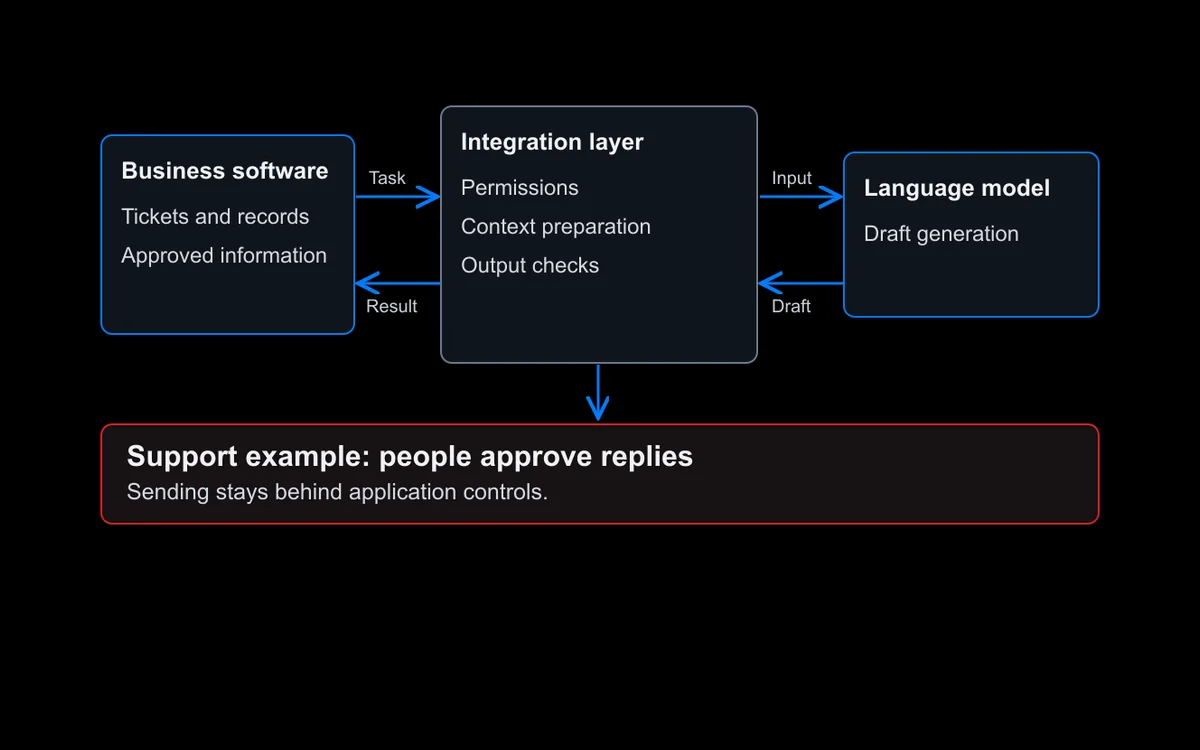
An AI agent is software that uses a language model to decide its next step and act on other systems through tools. Building one well is mostly engineering around the model: connecting it to your systems, limiting what it can do, and proving it behaves reliably. A capable AI agent development company should cover the whole path, not only the prompt.
At a minimum, expect these pieces of work:
- Discovery: confirming the task, the systems involved, and what “done” means, including whether a simpler workflow would do the job.
- Action and autonomy design: a list of every action the agent can take and whether it runs alone, gets logged, or waits for a person’s approval.
- Tool and system integration: narrow, well-described tools connected to your CRM, ticketing system, databases, or internal apps.
- Evaluation: a test set built from real cases, run repeatedly, with clear pass and fail criteria.
- Security: permissions enforced in the connected systems and defenses against manipulated inputs.
- Monitoring and handover: traces of every run, agreed metrics, documentation, and a plan for who maintains the agent.
Our guide to building agentic AI systems explains each of these parts in more depth.
Development Company, AI Agent Consultant, or Platform?
These three are often compared, but they do different jobs. An AI agent consultant or AI agent consulting company helps you decide what to build, assess feasibility, and plan the rollout. A development company designs, builds, and tests the agent itself. A platform vendor sells a product you configure. Many projects use more than one: a platform or framework underneath, custom tools and controls on top, and consulting at the start. If you are still deciding whether an agent is the right investment, a scoped AI business consulting engagement can come before any build.
Eight Questions to Ask, and What Good Answers Sound Like
General vendor checks still apply, such as team experience, data handling, and support. Our post on choosing an LLM development company covers those. The questions below are specific to agents, because agents take actions, and actions are where the real risk sits.
| Question to ask | A strong answer | A weak answer |
|---|---|---|
| 1. Does this task actually need an agent? | Maps the steps first, and may recommend a fixed workflow or automation for parts of it | Proposes an agent for everything |
| 2. Which actions can the agent take alone, and which need approval? | An action-by-action list with an autonomy level for each | “It’s fully autonomous” or no clear answer |
| 3. How do you limit what the agent can access? | Narrow tools, permissions enforced by the connected systems, actions run with the user’s own access rights | “The prompt tells it not to do that” |
| 4. How will you test it before launch? | A test set drawn from real cases and failures, run several times, including edge cases | A live demo and manual spot checks |
| 5. How do you handle prompt injection? | Separates untrusted content, limits privileges, requires approval for high-risk actions, and admits no method is foolproof | “Our model can’t be tricked” |
| 6. What happens when something goes wrong? | Step, time, and cost limits, retry rules, and a hand-over to a person with context | Only the happy path is described |
| 7. What will we see after launch? | Traces of every model call and tool call, plus completion, escalation, error, and cost metrics | “We’ll keep an eye on it” |
| 8. Who owns the code, prompts, test sets, and data? | You do, with documentation and a handover plan | Locked inside a proprietary platform, or unclear |
Table 1. Agent-specific questions for an AI agent development company, with examples of strong and weak answers.
Some of these answers can be checked against published guidance. Anthropic’s engineering team recommends adding agent complexity “only when it demonstrably improves outcomes”Source [1], so a partner who questions whether you need an agent is showing judgment, not a lack of ambition. OWASP, the nonprofit open security project, recommends limiting the tools and permissions an agent has, running actions in the user’s context, and implementing authorization “in logic rather than relying on an LLM to decide if an action is allowed or not,” with every request to a connected system checked against security policiesSource [2]. On prompt injection, OWASP states plainly that “no reliable prevention mechanism exists today”Source [3], so an honest answer to question 5 includes limits, not guarantees.
On testing, Anthropic notes that the capabilities “that make AI agents useful” also “make them harder to evaluate,” and suggests that “20-50 simple tasks drawn from real failures is a great start”Source [4]. A company that cannot describe its test set in similar terms is likely relying on demos. For question 7, ask whether traces follow an open standard: OpenTelemetry’s conventions for AI systems record each agent run with a span for every model call and tool call, including token countsSource [5], which keeps your monitoring portable if you change partners later.
Red Flags Worth Taking Seriously
Any one of these is a reason to slow down and ask more questions:
- Only a demo, never production. The demo uses clean inputs, every tool call succeeds, and there is no example of how an agent behaved after launch.
- No answer on approvals. The company cannot say which actions need a person’s sign-off.
- Permissions handled in the prompt. Safety depends on the model following instructions rather than on access controls in your systems.
- No evaluation plan in the proposal. Testing appears only as a final step, or not at all.
- Guaranteed outcomes. Promises of specific accuracy, savings, or timelines before discovery has happened.
- Lock-in by default. Your prompts, tools, test sets, or data live in a platform you cannot export from.
- A different team after signing. Senior people in the sales process, unnamed people in the build.
How AI Agent Development Engagements Are Usually Structured
Well-run agent projects tend to move through similar stages, and a good partner will describe them before quoting a price. Each stage should end with something you can check.

- Discovery. The company works with your team to pin down one task, the systems it touches, every action the agent might take, and what success looks like in numbers you already track. This is also where it should test whether an agent is needed at all, or whether part of the work suits a fixed workflow. Expect workshops with the people who do the task today, access to sample data, and a short list of open risks. What you should receive: a written scope, an action list with an autonomy level for each action, and a test plan you can read and challenge.
- Pilot build. The team builds the simplest version that can do the task, usually one agent with a few narrow tools, connected to test copies of your systems rather than live ones. Ask to see it working on your own examples, not a generic demo, and ask which actions are switched off or stubbed for now. What you should receive: a working agent in a test environment, plus a list of the tools it uses and the access each one needs.
- Testing. The agent is run many times against a test set built from real cases, including awkward edge cases, missing information, and deliberately manipulated inputs such as instructions hidden in a document. The point is to measure, not to impress: how often it completes the task, how often it should have stopped and did not, and what each run costs. What you should receive: results measured against the criteria agreed in discovery, with the failures listed, not just the successes.
- Limited launch. A small group of real users starts working with the agent, with approval required for any action that changes something and tracing switched on for every run. Someone on your side reviews its proposals and flags mistakes, and the development team fixes them and adds each one to the test set. What you should receive: real usage data, a log of what reviewers changed or rejected, and an updated test set.
- Monitoring and widening. Autonomy is widened one action at a time, and only where the data from the limited launch shows the agent handles that action reliably. Monitoring, support, and regular reruns of the test set continue after launch, because model updates and changes in your systems can affect behavior. What you should receive: an agreed operating and support plan, named owners on both sides, and a schedule for reviewing the agent’s results.
Ask each company you are comparing to walk through these stages for your project specifically. Vague answers about what happens at each stage, or a plan that jumps from demo to full launch, tell you more than any slide deck.
Some companies offer discovery as a small, separately priced step. That is a good sign: it gives both sides a clear scope before anyone commits to a full build, and it gives you something to compare across shortlisted companies.
What Drives AI Agent Development Cost
AI agent development cost depends mostly on scope: how many actions the agent takes, how many systems it connects to, how much approval and security the work needs, and how thorough the testing is. Running costs, mainly model usage per task and ongoing support, come on top of the build and should be estimated separately.
The main cost drivers to discuss with any company:
- Number and type of actions. Read-only actions are simpler than actions that change records, move money, or contact customers.
- Systems to integrate. Each CRM, database, or internal tool adds connection, permission, and testing work.
- Approval and security needs. Review screens, audit logs, and regulated data add design and testing effort.
- Evaluation depth. Larger, more realistic test sets cost more to build and save more later.
- Running costs. Model usage grows with steps per task and task volume, so ask for an estimate per task, not only a build price.
- Support after launch. Monitoring, updates, and test-set maintenance are ongoing work.
Ask each company to break its estimate down by stage and to list its assumptions. Two quotes that look far apart often describe very different scopes.
How to Compare Your Shortlist
A fair comparison is more useful than a long list. Shortlist around three AI agent development companies, give each the same written brief, and ask each the eight questions in Table 1. Score each answer as strong, partial, or weak, and weigh questions 2, 3, and 4 most heavily, because they decide how safely the agent will behave.
For small and medium businesses comparing AI agent development companies, the same questions apply at a smaller scale. Start with one narrow task, ask for a fixed-scope discovery and pilot, and check running costs per task early, since they matter more when budgets are tight.
How SensViz Approaches AI Agent Development
At SensViz, agent projects start by confirming whether an agent is the right tool, and we choose the simplest reliable design for the task. Our agents are built with bounded autonomy, defined permissions, human approval where actions carry risk, and traceable runs. Where a project is still at the idea stage, that first conversation works as consulting: scoping the task, the risks, and whether a simpler workflow would do.
For a concrete example, Spec to SaaS, a specification-driven AI development platform SensViz built for Fossilite, answers several of the questions in Table 1 in its design:
- Approvals (question 2): the workflow pauses for a person to approve the requirements and the technical blueprint before any code is generated, and a rejection sends the work back for another attempt.
- Failure handling (question 6): integration problems, such as type errors, become input to focused repair tasks, and queued stages retry automatically when they fail.
- Visibility (question 7): every stage, approval, and result is recorded, and a traceability report maps each agreed requirement to the files generated for it.
You can read more about how we work on our agentic AI development page, and use the questions above when you speak to us.
Frequently Asked Questions
These cover questions buyers commonly ask once they start comparing companies.
How Much Does It Cost to Build an AI Agent?
It depends on scope rather than on a standard price. A read-only agent working with one system usually costs much less than an agent that changes records across several systems with approval steps and audit logs. Ask for an estimate broken down by stage, with assumptions listed, and a separate estimate of running costs per task.
How Long Does It Take to Build an AI Agent?
It depends on the number of actions, systems, and approval steps involved. A narrow pilot is much faster than a production system that handles many cases. Be cautious of any company that promises a production-ready agent without time set aside for discovery, testing against real cases, and a limited launch before full rollout.
Should We Hire an In-House Team or Use an AI Agent Development Company?
Build in-house when agents will be a long-term core capability and you can hire people with integration, security, and evaluation experience. Use a development company to move faster on a first project or fill skill gaps. Either way, make sure your team ends up owning the code, test sets, and knowledge needed to maintain the agent.
Sources
- [1] Anthropic, “Building Effective AI Agents (opens in a new tab),” 19 December 2024.
- [2] OWASP Gen AI Security Project, “LLM03:2026 Excessive Agency (opens in a new tab),” OWASP Top 10 for LLM Applications 2026, released 3 August 2026.
- [3] OWASP Gen AI Security Project, “LLM01:2026 Prompt Injection (opens in a new tab),” OWASP Top 10 for LLM Applications 2026, released 3 August 2026.
- [4] Anthropic, “Demystifying evals for AI agents (opens in a new tab),” 9 January 2026.
- [5] OpenTelemetry, “Inside the LLM Call: GenAI Observability with OpenTelemetry (opens in a new tab),” 14 May 2026.