

Agentic AI
AI Agents vs Agentic AI vs LLMs: What's Actually Different
Written by Tehreem FatimaReviewed by Umaid Asim
Published 11 min read

AI agents vs agentic AI is a comparison that trips up a lot of people, and the large language model (LLM) usually gets mixed in as well. The three terms are related, but they are not interchangeable. An LLM is a model. An AI agent is a system built around a model. Agentic AI describes how much a system plans and acts on its own.
The difference matters when you are scoping a project, because each one needs a different amount of engineering, data access, and control. This post explains each term in plain language, compares them side by side, walks through one request handled three ways, and shows how to decide which one a problem actually needs.
How Do LLMs, AI Agents, and Agentic AI Differ?
An LLM generates text from a prompt and cannot act on anything by itself. An AI agent wraps an LLM with instructions, tools, and a loop so it can complete a task, such as looking up an order. Agentic AI describes systems where AI plans and carries out multi-step work with more autonomy, often across several coordinated agents.
What Is an LLM?
A large language model (LLM) is a model trained on large amounts of text to understand and generate language. Given a prompt, it can answer questions, summarize, classify, translate, and draft. On its own it only produces text: it does not look anything up, change a record, or remember past conversations unless the software around it adds that.
That boundary is the core difference between an LLM and an AI agent, and it holds even when an LLM appears to use tools. OpenAI’s documentation describes a tool call as “a special kind of response” the model returns when it decides a tool is needed; the developer’s application then executes the code and sends the result back to the modelSource [1]. The model asks. The surrounding software acts.
Many useful products stop at this level: chatbots that answer from company documents, drafting assistants, document summarizers, and classification services. Our generative AI development work covers applications of this kind, where the model’s job is to work with text rather than to take actions.
What Is an AI Agent?
An AI agent is software that uses an LLM to decide what to do next toward a goal, calls tools to act on other systems, checks the results, and repeats until the task is done or a limit is reached. The LLM makes the decisions; the instructions, tools, memory, and limits around it make it an agent.
Anthropic’s engineering guidance defines agents as systems where LLMs “dynamically direct their own processes and tool usage”Source [2]. In practice that means the path is not fixed in advance. A support agent asked about a late order might look up the order, see that it has shipped, check the carrier’s tracking, and only then draft a reply. A different request would lead it down a different path.
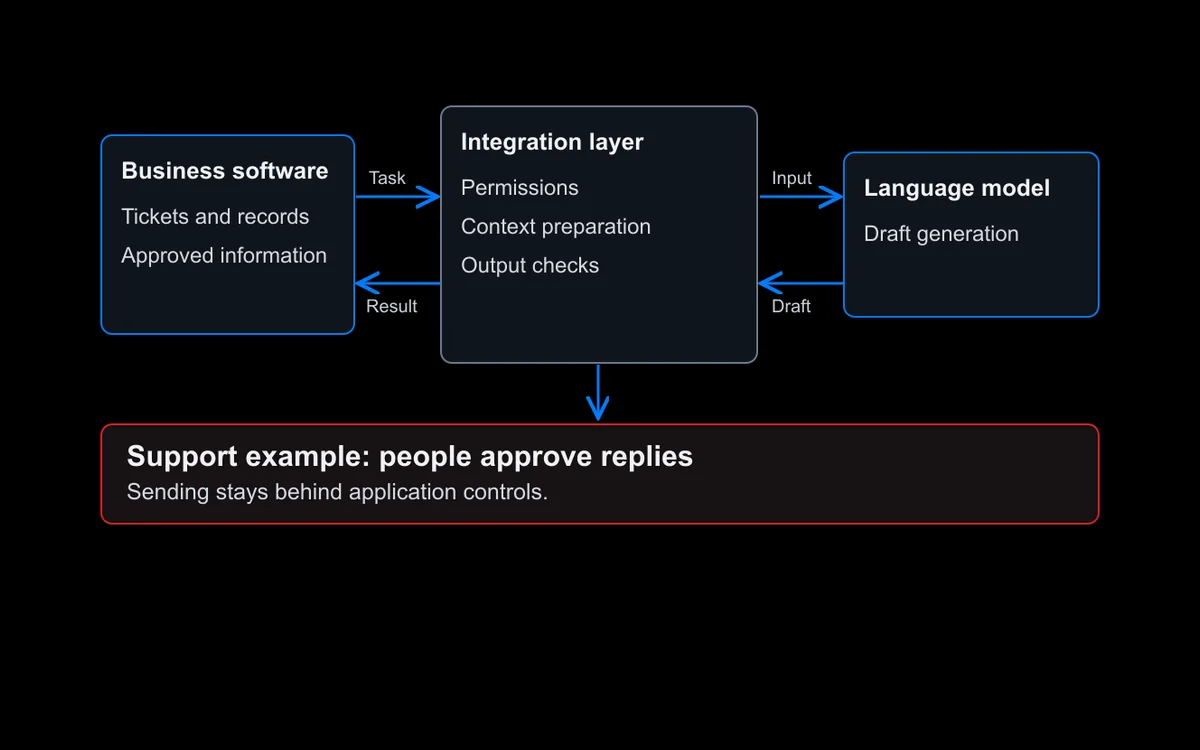
An agent is only as reliable as the parts around the model. A production agent also needs clear instructions, well-defined tools, permission controls, stopping rules, human approval for risky actions, and a record of what it did. For a closer look at each of these parts, Fossilite’s anatomy of a production AI agent breaks them down one by one.
What Is Agentic AI?
Agentic AI describes AI systems that pursue a goal with some independence: breaking work into steps, choosing actions, using tools, and adjusting as results come in. The term is used in two ways: as a property any AI system can have in degrees, or for larger systems in which several agents coordinate on complex work.
Both uses appear in authoritative sources, which is a large part of the confusion:
- Agentic as a spectrum. Anthropic groups both fixed workflows and open-ended agents under the umbrella of “agentic systems,” and separates them by how much of the path the model controlsSource [2]. Under this view, a single agent is already agentic AI.
- Agentic as a multi-agent paradigm. A 2025 research taxonomy by Sapkota, Roumeliotis, and Karkee describes AI agents as modular systems “for task-specific automation,” and agentic AI as “a paradigm shift marked by multi-agent collaboration, dynamic task decomposition, persistent memory, and coordinated autonomy”Source [3]. Under this view, agentic AI is the larger, coordinated system, and a single agent is one building block inside it.
So the practical difference between AI agents and agentic AI depends on who is using the terms. When a vendor, partner, or internal team says “agentic AI,” ask which one they mean. One agent with some autonomy and a coordinated system of several agents carry very different costs, risks, and build effort. For the agentic AI vs LLM question, the gap is wider still: an LLM is one component, while an agentic system is a whole design built around one or more of them.
You may also see the term “agentive AI.” It is generally used for AI that acts on someone’s behalf, and in everyday use it overlaps almost entirely with agentic AI.
AI Agents vs Agentic AI vs LLMs: Side-by-Side Comparison
The table below compares the three using the second, multi-agent meaning of agentic AI, since that is where the gap with a single AI agent is easiest to see. For AI agents vs agentic AI, look at who decides the steps and what can go wrong. For the AI agent vs LLM question on its own, the second row is the one that matters: only the agent can act.
| LLM | AI agent | Agentic AI system | |
|---|---|---|---|
| What it is | A model that understands and generates text | A system that uses an LLM and tools to complete a task | A system design in which AI plans and carries out multi-step goals, often with several agents |
| Can it act on other systems? | No. It can only request a tool call | Yes, through the tools it is given | Yes, often across several systems |
| Who decides the steps? | The person writing the prompt | The agent, within one task | The system, across a larger goal, inside limits people set |
| Memory | Only the current conversation, unless the application adds more | Tracks the steps and results of the current task | Often keeps shared state across steps, agents, and sessions |
| Typical example | Drafting a reply to a customer email | Looking up an order and drafting a reply with the real status | Handling a delayed-order case end to end, from investigation to a proposed refund |
| Main risk | Wrong or invented text | A wrong action taken through a tool | Errors that compound across many steps and agents |
| Relative build effort | Lowest | Moderate | Highest |
Table 1. How LLMs, AI agents, and agentic AI systems differ. Build effort is relative and depends on the use case.
The risk row is easy to overlook. Anthropic notes that “the autonomous nature of agents means higher costs, and the potential for compounding errors”Source [2]. Each step up the table adds capability, and each one also adds places where something can go wrong.
One Request, Three Ways
To make the difference concrete, here is one illustrative customer request handled at each level: “My order #4812 is late. What happened, and can you fix it?”

- LLM alone. It can explain common reasons orders are delayed and ask for more details, but it cannot see order #4812. Anything specific it says about the order would be a guess. If someone pastes in the order details, it can explain them clearly, but it still cannot check the carrier or change anything. It needs no access to your systems, so the main risk is a confident answer that sounds right and is not.
- AI agent. It looks up the order, checks the carrier’s tracking, finds that the parcel is held at a depot, and drafts a reply with the real status. A person reviews the draft before it is sent. To do this it needs read access to the order system and the carrier’s tracking, and a rule that it drafts but does not send. The main risk is a wrong lookup, such as the wrong order, so the draft should show where each fact came from.
- Agentic AI system. A coordinating agent splits the case. One agent investigates the order and carrier status, another checks the refund policy and the customer’s history, and the coordinator proposes a partial refund with a reply. A person approves the refund, and the system then updates the ticket. It needs everything the single agent needs, plus access to the refund policy and customer history, a refund tool that can only propose amounts within policy, and a record of what each agent found. The main risks are a mistake in one agent’s findings carrying into the final decision, and a refund going out without the right approval.
The third version saves the most work, and it also touches the most systems. That is why the right choice depends on the task, not on which option sounds most advanced.
A Real Example: Where Spec to SaaS Fits
Real systems rarely sit neatly on one level. Spec to SaaS, a specification-driven AI development platform SensViz built for Fossilite, shows how the three terms combine in practice.
- LLMs do the language work. Language models write the requirements, plan the application’s data, APIs, and pages, and generate backend and frontend code.
- Agent-like tasks act on the output. Specialist model tasks produce structured results that are checked against defined schemas, and when integration finds problems, such as type errors, a repair task uses that feedback to fix the code.
- The whole system is agentic, within fixed stages. A custom orchestration layer coordinates nine stages, from intake to a packaged code repository, and pauses for a person to approve the requirements and the technical blueprint before any code is generated.
In Anthropic’s terms, the overall path is closer to a workflow than an open-ended agent, because the stages are fixed in codeSource [2]. That is a deliberate design choice: the model decides how to do each task, while the order of the work and the approval points stay under control.
Which One Does Your Problem Need?
Start with the simplest option that can do the job, and move up only when the task requires it. Use an LLM on its own when the work is text in and text out. Use an AI agent when the task needs information or actions from other systems. Consider a multi-agent system only when a single agent measurably struggles.
A few questions make the choice clearer:
- Does the task only involve text a person provides? An LLM application is usually enough, such as summarizing a contract or drafting a reply from notes.
- Does it need live data or actions in other systems? Then it needs tools, which means an AI agent. If the steps are the same every time, a fixed workflow or AI automation is often simpler and cheaper than an agent.
- Does the right next step depend on what the last step found? That is where an agent earns its cost over a fixed workflow.
- Has a single agent actually hit its limits? Google Cloud’s architecture guidance recommends starting with a single agent and notes that its performance can drop as it takes on more tools and more complex tasksSource [4]. That is the point to consider several coordinated agents, not before.
More Autonomy Needs More Control
Every tool an agent can use is a permission, and every step it takes on its own is a decision nobody reviewed. OWASP, the nonprofit open security project, ranks “Excessive Agency” third in its 2026 Top 10 for LLM applications and traces it to three causes: excessive functionality, excessive permissions, and excessive autonomySource [5].
The controls scale with the level. An LLM application needs checks on what it writes. An AI agent also needs narrow tools, permissions enforced by the systems it connects to, and limits on how long it can run. An agentic system needs all of that plus human approval for high-impact actions and a full record of what each agent did. Our building agentic AI systems guide covers how to set these up.
Working Out What You Need
SensViz designs and builds LLM applications, single AI agents, and multi-agent systems, and helps teams decide which level a task actually needs before anything is built. If you are weighing these options, our agentic AI development team can help you scope it.
Frequently Asked Questions
These cover questions that often follow once the three terms are clear.
Is Agentic AI the Same as Generative AI?
No. Generative AI creates content, such as text, images, or code, from a prompt. Agentic AI pursues a goal by planning steps and taking actions through tools. The two usually work together: most agentic systems use a generative model, typically an LLM, to decide what to do next, while tools and software carry out the actions.
Is a Chatbot an AI Agent?
Not necessarily. A chatbot that only answers questions from what it already knows, or from documents it is given, is an LLM application. It becomes an AI agent when it can use tools to act for you, such as checking an order, booking a slot, or updating a record, and decide which steps to take to finish the task.
Can an AI Agent Work Without an LLM?
Yes. The idea of a software agent is much older than LLMs, and earlier agents relied on rules or narrower machine learning models. Today, though, “AI agent” usually means an LLM-based agent, because language models made it practical to handle open-ended requests, choose tools, and plan steps without every path being coded in advance.
Sources
- 1. OpenAI, “Function calling,” OpenAI API documentation, accessed 4 October 2026. https://developers.openai.com/api/docs/guides/function-calling (opens in a new tab)
- 2. Anthropic, “Building Effective AI Agents,” 19 December 2024. https://www.anthropic.com/engineering/building-effective-agents (opens in a new tab)
- 3. Sapkota, R., Roumeliotis, K. I., and Karkee, M., “AI Agents vs. Agentic AI: A Conceptual Taxonomy, Applications and Challenges,” arXiv:2505.10468, v5, 30 September 2025. https://arxiv.org/abs/2505.10468 (opens in a new tab)
- 4. Google Cloud Architecture Center, “Choose a design pattern for your agentic AI system,” last updated 28 May 2026. https://docs.cloud.google.com/architecture/choose-design-pattern-agentic-ai-system (opens in a new tab)
- 5. OWASP Gen AI Security Project, “LLM03:2026 Excessive Agency,” OWASP Top 10 for LLM Applications 2026, released 3 August 2026. https://github.com/GenAI-Security-Project/GenAI-LLM-Top10/blob/main/2026/final/LLM03_ExcessiveAgency.md (opens in a new tab)